Showing posts with label Baja. Show all posts

Tuesday, June 18, 2013

Reversing Direction; UP Mexico Highway 1 – June 5 -10

Once Abracadabra was in Summer Suspended Animation, we threw the t-shirts we had been wearing for the last three days of the decommissioning process into the trash and flew to La Paz on Aereo Calafia’s one-hour and forty-five minute flight across the Golfo de California.  From there we drove to Ensenada. 

Maybe it was the “return journey effect” (that a return trip often seems shorter than the original journey), better roads as a result of post-Hurricane Paul repairs, lighter traffic because it was off-season, or some combination – but this trip seemed easier than our drive south in October.

One difference was that, rather than receiving only a cursory glance, our car was actually searched at most of the military checkpoints.  Molly’s favorite “Mexican Moment” of the trip:  During a discussion of her passport picture (which is of a younger-looking brunette!) a handsome 20-something soldier looked closely at her and her picture and told her she had “beautiful eyes”.  We dare you to imagine a US or Canadian border officer complimenting someone’s eyes!  Viva México.

La Paz, Baja California Sur to Loreto, BCS -- 347 kilometers (216 miles): 

Our first hurdle was getting to the car storage lot only two kilometers south of the airport.  Like many airports in Mexico, official airport taxis in La Paz have flat-rate fares based on a zone system.  This works well for most arriving tourists; even if the fare exceeds what one might be able to negotiate, it’s consistently applied.  Unfortunately the system lacks flexibility for those traveling only two kilometers along the airport road!  We finally threw up our hands in frustration and paid the full (really galling) 300 peso ($25-ish) zone fare.  Lesson learned: arrange for a ride if you’re not going into town. 
Our little Volvo, which had been in the good care of La Paz Mini Storage / Park ‘N Fly La Paz, looked great.  We were particularly pleased to see that auto body work we had arranged for at a bargain price (about one-third of what we would have paid in California).  Once again, Mexican craftsmen had made a lie out of “you get what you pay for”; they had even matched the odd “Volvo green” paint color.    
An Aside:  This body work removed the results of an encounter Molly had with a parking lot post on the day we decamped from Sacramento in September, 2011.  That encounter wasn’t spectacular – but the effect on Molly was – and the little back panel crunch has acted as a reminder of how hard it was to “just sail away”.  We don’t need that reminder any more.

Back to La Paz to Loreto, 2013:  Our October trip south down Mexico Hwy 1 [2012/10/la-paz-and-abracadabra-is-lovely] followed the path of Hurricane Paul and as a result involved driving very slowly over several washed-out stretches of highway.  This year we drove on long bits of brand new highway. 
In Loreto we stayed at the Hacienda Suites Hotel.  This “hotel” is a testament to how nice landscaping and a clean pool can make an otherwise unglamorous motel inviting.  We’ll be charitable and suggest that the hotel’s use of the term “suites” is due to a translation glitch -- because we don’t think the little table with two chairs in the “standard suite” should be enough to qualify the otherwise ordinary (though very clean) motel room for suite status.
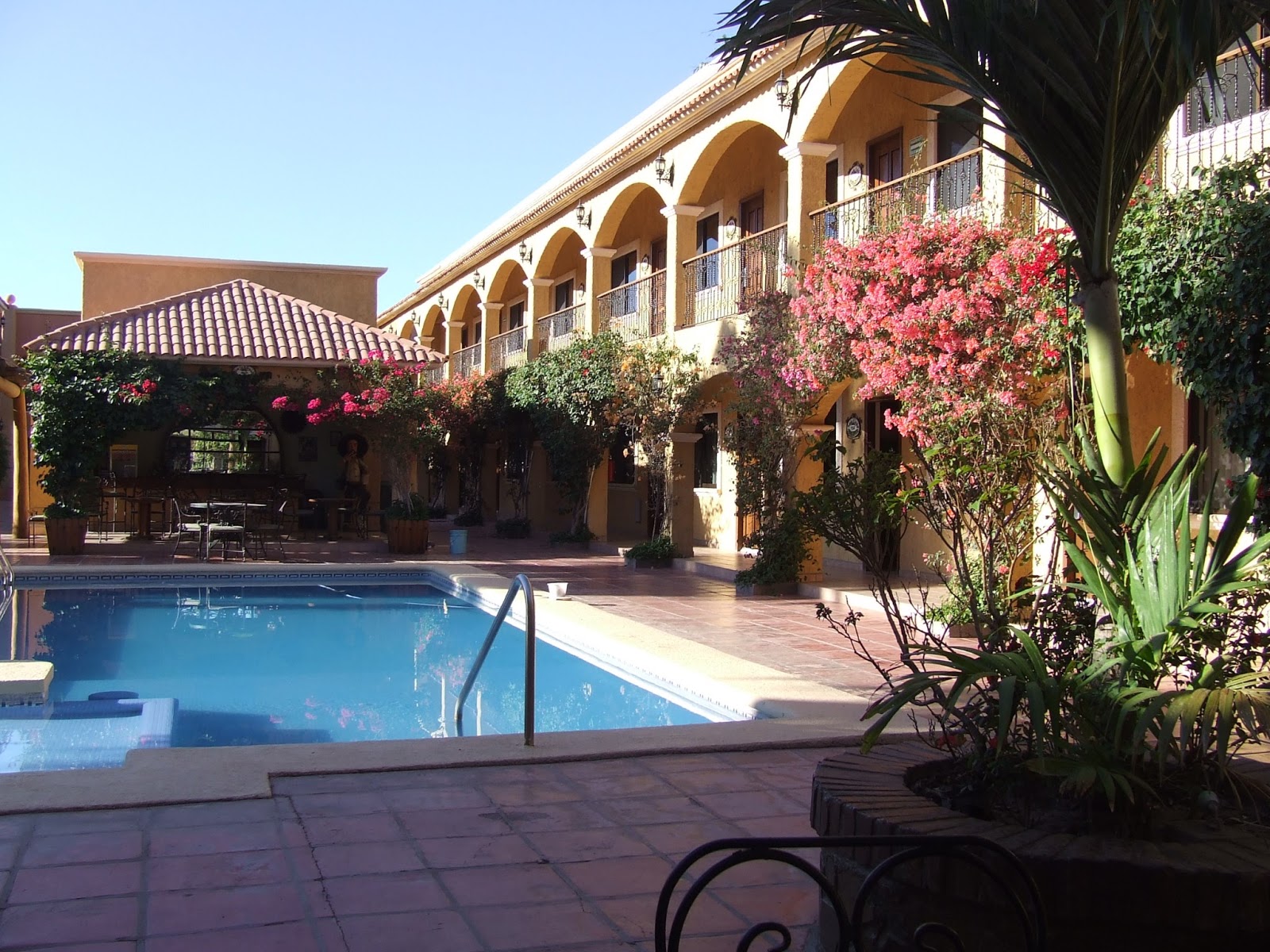
The Hacienda "Suites" Hotel
Loreto, BCS to Riscal de Cataviña, Baja California -- 571 kilometers (355 miles)
This was a long drive, with spectacular scenery on winding roads that could benefit from shoulders and/or pull-outs for slow traffic (us when Molly is driving).  Our destination was the Riscal de Cataviña boulder fields.  See our posting on this really cool place from last year [2012/10/poking-along-down-baja-california-norte] if your reaction is the same as ours: boulder fields?  This area has very unique and spectacular scenery. 

In this “middle of nowhere” place we stayed at the Hotel Mision Cataviña, a charming hotel with a lovely courtyard, a nice-ish pool and a beautifully landscaped desert walking trail that was perfect for a post prandial stroll.  The restaurant served a pleasant dinner and breakfast, the room was charmingly decorated and the bed was comfortable.  We have marked the location of this hotel on our Baja map.


Hotel Mision Catavina
Hotel Una Mas
Desert Walk
Riscal de Cataviña, BC to Ensenda, BC --  360 kilometers (224 miles)

Maybe it’s the result of Molly’s career in government finance -- but as we drove into the northern state of the Baja California we kept thinking that money budgeted for that state's roads in 2012/13 must have been diverted to pay for Hurricane Paul-required repairs in Baja California Sur.  As we drove north the new pavement disappeared, potholes got deeper and more frequent and trucks got bigger and more frequent.  The traffic increase was particularly noticeable as we entered the agricultural region around Ensenada and the other Lázaro Cárdenas.  Baja California is a major source of produce for North America, all of which travels by truck.

In Ensenada we again stayed at the Estero Beach Hotel, a place we enjoy not only because of its quiet location on an estuary south of Ensenada but because of the decor which doesn’t appear to have changed (except to be refreshed and repainted) since the hotel was opened in the 1950’s.  Before we go back we’re going to buy some Mad Men-esque clothes and some electronic cigarettes . . .
The next morning we took a short drive south on Mexico Hwy 1 to see La Bufadora – one of Ensenada’s “must see” tourist attractions.  The “blowhole” is pretty cool (it’s actually just a very narrow inlet into which the waves crash and spew dozens of feet high), but the real reason to go is to experience tourist frenzy.  To get to the spewing water, which was fun to see:


one must walk a veritable gauntlet of tourist venders.  Between the parking lots and La Bufadora one can purchase:

Bedspreads

Refreshment

Luchador Masks
Candy

And Spiritual Enlightenment
Oh yes, it’s touristy.  But everyone should at least once: visit San Francisco’s Fisherman’s Wharf, ride on the Maid of the Mist at Niagara Falls, and go to a luau in Hawai’i.  So don’t be too cool to go. 

From there we went to the Santo Tomas valley, one of two small wine-growing areas outside of Ensenada.  We visited the Santo Tomas winery (very old and now very large), tasted their wines and had a cheese and Serrano ham picnic.  Location – lovely; wines – just fine (we bought one bottle of white); cheese – as with most Mexican cheeses good but young; and Serrano ham – great.
Valle de Guadalupe – “Mexico’s Napa”
Mexico’s primary wine growing area is in a valley north-east of Ensenada – the Valle de Guadalupe.  We had planned to stay in the valley for a couple of nights in one of the charming-sounding hotels we had read about.  Unfortunately, our “plans” hadn’t extended to actually making any reservations.  Lesson learned:  to visit the Valle de Guadalupe, particularly on a weekend, plan ahead – a long time ahead.  One hotel very kindly avoided sounding snooty when they told us their next weekend availability would be in October . . .

The Estero Beach Hotel was also full so we found ourselves scrambling for another hotel in Ensenada.  We landed downtown at the Villa Fontana Inn, which has an odd, kitschy “Victorian” motif.  But it was sparkling clean (love those little paper bands on the toilet seat that attest to the toilet’s cleanliness -- do motels still do that in El Norte?) and, once the crowds of pre-teen girl gymnasts and pre-teen boy baseball stars left the pool, it was quiet. 

Our day trip to the Valle de Guadalupe was fun.  We stopped and tasted at:

Nativo, a winery tucked way (way) down a windy dirt road, that has a lovely little house for rent (two bedrooms, one bath, kitchen, and hammock - $100 a night for two guests).  Our arrival coincided with the departure of a large Mexican-American family that had been enjoying a two-day long birthday celebration at the house.    

Essential Rental House Equipment

The winemaker arrived from his house down the road to say goodbye to the departing San Diegans, and took us to his cellar and gave us barrel tastes.  He told us about his training in Spain and was marvelously enthusiastic about his product.  There was never a moment when we sensed we were part of a corporate marketing campaign à la Napa.  And he enthusiastically and generously routed us to other wineries in the area! 

Bryce, consulting Benjamin
So, not so much like Mexico’s Napa; more like Mexico’s Amador Foothills or Eldorado County (wine areas near Sacramento).  We bought a bottle of a Zinfandel blent called Nativo Kumiai after a pre-Columbian tribe from the area. 

Vinas de Garza, our second stop, was a more corporate wine experience, interesting as a look into how the larger Valle de Guadalupe wineries are blending wines to appeal to the emerging Mexican wine market.  This winery is a beautiful place, but it didn’t feel like a “find”:

Wine Futures

Vinicola Trés Mujeres, was our final stop.  There the tasting was handled by one woman in a dusty little cave-like room.  We purchased a bottle of La Mezcla del Rancho (the ranch mix), a blend of Cabernet and Grenache.  It’s a perfect wine to go with spicy Mexican steak. 

 
Tres Mujeres plus one

Back in the USofA – June 10:

The next day we drove to Tecate along Highway 3 (the wine route), believing that the Tecate border crossing would be faster than at Tijuana.  It may be that we made the better choice, but our experience has resulted in a new Family Travel Rule:  Never attempt any border crossing (even one purported to take only 20 minutes) on a less than full stomach. 
For three hours we crawled along beside the infamous border fence in the sun.  On the Mexican side, every inch of the fence is covered with advertisements or painted with art  and we were offered the opportunity to purchase gum, water or tamales from strolling venders.  We weren’t able to see the source for the tamales (a Family Rule about street food) so we declined the offer -- though by the time we reached the border guard station we were sorry we hadn’t taken a gamble on them! 

The area on the US side of the fence is an empty DMZ for several miles.  Gazing at the vast desert we again regretted passing on the tamales.  It was an hour before we found what we were looking for -- one of the “first things I want in America” items: a turkey sandwich on sourdough.  Delicious. 

Our Summer “Vacation” Plans -- The Short Version:

  • A week in the LA area visiting The Brothers (currently underway);    
  • Five weeks in Sacramento/San Francisco house-sitting for friends and staying in the occasional hotel (probably without paper rings on the toilet seat); 
  • A week in Oh Canada visiting family;  and then
  • August and September in a one-bedroom house we have rented in Ciudad Guanajuato, Estado Guanajuato, Mexico.  We plan to blog only about this portion of our summer -- unless there are requests for descriptions of our annual eye exams and dental visits in Sacramento . . . ? 
  • Back to Travels on Abracadabra

At the moment it feels very good to be in the USofA – no matter how much we complain about it.  That’s our Constitutional Right, you know.  

Friday, December 21, 2012

Adventures in Anchoring and Death of a Spinnaker -- December 8 - 19

Our eleven day trip from Puerto Escondido south to La Paz included several anchoring skill-building exercises and three equipment tragedies (more than malfunctions – actual death in the line of duty).  As we consider our trip from the comfort of our dock at Marina Palmira, listening to the gentle sounds of Cuban danzon from the radio on the next boat, we can be philosophical: it’s all a learning experience!  

Bahia Candaleros – December 8:  We had a pleasant seven mile sail from Puerto Escondido to Bahia Candaleros where we were last seen having a Thanksgiving drink at the Presidential Suite of the hotel.  We returned to the beach bar of the hotel looking forward to the good (all things being relative) pizza served there.  What we had inconveniently forgotten was that cocktail hour in Bahia Candaleros might also be called the mosquito hour.  We were reminded of this when our waiter delivered a complimentary bottle of bug spray along with our cocktails!  By the time we had soaked ourselves down with bug spray and finished our cocktails night had fallen, the mosquitos had disbursed and we were able to enjoy the salad and pizza unmolested.  Next time we’ll start our evening fashionably late. 

Our first equipment tragedy was as we were anchoring at Bahia Candaleros.  To avoid mangling his toes in the windlass (note to non-sailors – the piece of equipment that feeds the anchor and chain out from the boat to the bottom of the anchorage) Bryce pulled back and in the process lost his grip on the windlass handle which proceeded to do a graceful, aerobatic flip into the bay.  Once again we were reminded that snorkel gear is not just for fun.  The next morning, after the sun was high enough to aid our search, we donned snorkels and masks and swam out to see if we could find the handle.  Unfortunately, we couldn’t spot it.  Bryce has now switched from wearing anchoring sandals to anchoring tennis shoes and is using the manual bilge pump handle as a replacement handle.  Lucky man, he’s been promised a new handle for Christmas. 
Bahia Agua Verde – December 9 – 13:  After giving up on our recovery mission, we sailed 17 miles south to Agua Verde and anchored behind a crowd of other boats. 

Abracadabra Anchored at Agua Verde

The first night was pleasant and we spent time in the cockpit with our “Star Maps for Beginners” book and I-Touch star program identifying some constellations.  We can now identify more than Orion!  On our second night a high wind in the Sea began sending waves wrapping around into the bay.  One of the boats in front of us had left so we had the opportunity (and were advised by others) to move further into the protection of the shoal.  Because the prior night had been so pleasant we didn’t think relocation would be worth the effort.  It would have been worth the effort.  The next morning, bleary eyed from having rocked-n-rolled all night, we were happy to see another better-situated neighbor departing, which allowed us to move further into the northern lobe of the bay.  Location, location, etc.

During our stay in Agua Verde, we made the acquaintance of Merry and Eric from Rhiannan who were kind enough to coach us on ways to cook fillets of sierra (Spanish Mackerel) that we had purchased from a local fisherman, provide directions for a hike and share weather information.  On our third day, friends from La Paz, Robert and Lucie on Grace, arrive with stories of their own adventures.
 
We followed Eric’s directions and enjoyed the hike past the old cemetery

Cemetery at Agua Verde

through a grove of date palms to another cove

Driftwood Art North of Agua Verde

and up a goat path along a hill to visit a cave.  Rather than leave our own red handprints at the cave (we’re not sure who first did that) 

Red Handprints at  Agua Verde Cave

we took “we were there” pictures:

Bryce Was There
And So Was Molly

The villagers at Agua Verde raise goats and the anchorage is known for the sound of goat bells on the hill in the evening.  During our stay a survival drama played out among the goat population on the hill above us.  A young goat was caught out on a ledge on the hillside, and for two days we watched anxiously as its worried mother looked for and called to it as the local vulture gang circled.  There was a happy ending -- we saw the mother escorting a young goat up the side of the hill one afternoon.  Success was confirmed when the vultures disbursed.  Who needs television when one has a heart-tugging PBS Nature special unfolding outside one’s door? 

We delayed our departure from Agua Verde because a southerly night wind was expected and Agua Verde is one of the few south-wind anchorages in the area.  On the morning of the expected southerly every other boat in the bay departed for the south side of the bay.  Fighting off our abandonment feelings, we decided to stay put because the weather predictions called for the wind to shift from the north later during the night.  We huddled below and listened to the rain and wind like Seattle sailors.  As it turned out, the wind shift came to pass and we sat as comfortably as those that had relocated.    

The exciting part of the “south wind kerfuffle” came at about 22.00 when we heard a boat approaching.  As we were the only boat left in the northern part of the bay, which can accommodate a number of boats at anchor, we weren’t concerned.  But then we saw the new arrival trying to anchor between Abracadabra and a (we thought) too-near rocky shore.  The clouds had obliterated any starlight or moonlight.  The newly arrived boat was a few lights in the dark and the sound of a motor – all very, very close to us, it seemed.

A polite exchange ensued between Bryce and the (undoubtedly exhausted) invisible single-hander trying to anchor near us:  “Are you comfortable with where I’m anchoring?  I’m afraid my perspective may be off in the dark.”  “Well, you’re plenty close.  There’s a lot of room in front of us.  Can we show you another suggestion?”  [In the background Molly was hissing things like:  “Holy f*^# -- if he sets there he’ll swing right on top of us!  Oh, cr@p!  He’s going to run into those rocks if he keeps going in that direction.  Jeeeezus, he’s close.”]

Fortunately, Bryce was able to talk the new arrival into a much safer place to anchor, though by the time he anchored Molly was positively vibrating – and not just from the night chill.  When we left Agua Verde in the morning we were happy to see his pretty little boat anchored comfortably in the middle of the bay, safe and sound.  Does he think we helped or does he think we were unreasonable?  We will never know!         

Southward Bound (returns to Timbabiche; San Evaristo; and Ensenada Grande on Isla Espiritu Santo) – December 14 – 17:  Our 21 mile trip from Agua Verde to Timbabiche was spent bringing out the sails and watching the wind die, turning on the motor and watching the wind come up; rinse, repeat.  By the time we arrived at Timbabiche we didn’t have time for adventures ashore.  The next day, from Timbabiche to San Evaristo (26 miles) we were able to sail . . . sloooowly . . . until we realized if we were going to make San Evaristo before dark (see above re: challenges of anchoring in the dark!) we would have to rely on the motor.  So, with winds at about 2 – 5 knots, we motored to San Evaristo.   
During the 28 mile trip from San Evaristo to Ensenada Grande (on Isla Espiritu Santo) the winds were brisk and from the north-north west which allowed us to sail the entire way.  Unfortunately, this was when we experienced the second equipment tragedy.  Fifteen minutes out of San Evaristo we put up the spinnaker and watched in horror as it shredded along the luff -- rrrrrrrrriiiiiip.  And our pretty little spinnaker was in two (or more).  Like much of our equipment it was not new when we got it, and we remind ourselves that used equipment should be expected to have a shorter life span than new.  But we are still saddened by the loss of our pretty little bargain sail. 


At the Dock in La Paz,Assessing the Damage

Ooooh, Baby, You Break My Heart

Ensenada Grande (where Bryce nursed his sinus infection with antibiotics five weeks before) was our home for two nights because the wind that made for a quick sail from San Evaristo strengthened, which suggested that we stay put in the ensenada’s good north-wind anchorage.  We sat at anchor in Ensenada Grande for two nights, listening to the wind howl in the rigging.  The wind wasn’t high enough to register in the scary-meter (the highest gust we saw was 20-knots) but it swept down from the hills surrounding the anchorage creating a howling sound that, as Bryce pointed out, was a bit like the sound track of Ice Station Zebra.        
On our last morning in Ensenada Grande the local rays put on a show at breakfast as though they were happy to have the scary night-time sounds over.  We drank coffee and watching them launch themselves four or five feet into the air and then land - slap – on the water, making a sound that brought back painful memories of childhood belly-flops.  Other rays would launch across the water like stones skipped by invisible giants.  Why the rays leap and splat like this is a mystery to us.
El Mezteño (Isla Espiritu Santo) – December 18:  We wanted to visit one more new place 
before returning to marina life so we motored in very light wind five miles south to El Mezteño, a pretty one-boat cove.  

El Mezteno

The sand was white and the water was warm-ish and startlingly clear.  We rowed to shore and scrambled over boulders until we gave up trying to call what we were doing hiking. 

So the Trail Would Be About Here . . . ?
Well, Maybe This Is The Trail . . . 

We walked the beach and watched the almost translucent crab run from our shadows.

When She Agreed To Row Back, The Shore Looked Closer 
We returned to the boat, had a beer and watched the crazy rays skip themselves across the water.  After dinner we identified a couple of additional constellations and commented on how the wind had shifted and was now coming from the west – the one area for which we had no wind or wave protection.  No concern, we told ourselves – it was only four knots.  No high winds were predicted.    

At about 21.00 the wind picked up and though it only rarely gusted to 20 knots, it was accompanied by swells of at least two meters (that’s 6 feet for the American readers).  Our little secluded cove had become a funnel for waves that were much higher than the winds warranted.  Abracadabra’s bow was bucking like a mechanical bull (to use an analogy you may be too embarrassed to admit you recognize – but we are old enough to recall that short-lived nightclub phenomenon).

Our first challenge was to determine what to do with the dinghy suspended over the side on its hoist.  Waves were splashing into it and could eventually make the weight too heavy for the hoist.  So we donned our PFDs (for non-sailors: personal flotation devices or life jackets), rode the mechanical bull in a dark only slightly relieved by the light of a bright quarter moon, lowered the dinghy and tied it off Abracadabra’s stern – hoping that we would find it attached in the morning rather than washed up on the beach! 

Cold, splashed and windblown we retreated below to discuss what else we should do to address this unfortunate turn of weather (something other than contemplating tossing up dinner).  As we discussed pros and cons of releasing additional anchor chain – a traditional way of addressing high winds – there was a huge BAM and the sickening sound of anchor chain running out uncontrolled --- clank-clank-clank-clank-clank.  We raced up the hatchway.  The sound stopped abruptly and the boat swung around like it was the victim in a rodeo calf roping event (ok… enough with the cowboy analogies, already!).  The anchor chain was taut again and the anchor was holding. 

The high waves had wrenched the snubber (for non-sailors: a hook on a piece of strapping that relieves the tension on the anchor chain) off the chain bending the snubber beyond repair (our third equipment tragedy), and then exerted enough force on the chain to pop off the windlass brake, which allowed the chain to dump noisily overboard.  The extra rope that follows the chain caught because Bryce had, as is his custom, cleated it at the bow.  Note to self: redundancy is a good thing in sailing.  Ha – no need to discuss the pros and cons of letting out more chain! 
Bryce let out a small amount of additional rope to give some stretch to the anchoring system.  Molly stood in the hatchway watching him ride up and down on the bow in the dark considering the best way of addressing his seemingly inevitable plunge into the six foot swell.  She decided his best chance was to grab onto the dinghy as he swept by . . . [Molly's note to self: make sure he ties on next time!]. 
Summary:  Bryce did not fall in, the dinghy stayed attached, and the anchor held.  We slept some (as much as one can sleep on an amusement park ride) and woke often.  The waves started to subside around 01.00.  There was a lot of energy expended in a very short time – by us and by the Sea.

Return to La Paz:  Fuzzy after from our busy night, we motored most of the way to La Paz, once again amazed that a night with so much wind could be followed by a morning with so little.  About five miles north of the start of the La Paz channel the wind came up and we were able to sail the rest of the way into Marina Palmira.  Sailing within the channel markers was like sailing a slalom run, and Bryce was a very Happy Captain. 

After the prior couple of noisy, active nights we were thrilled to tie up to a dock, have a hot shower and eat food cooked by someone other than Abracadabra’s galley wench.  Bryce is now on the internet ordering a windlass handle and an anchor chain snubber to be delivered by Santa Claus . . . and we're checking Santa's list to see if we've been good enough for a new spinnaker . . .

Wednesday, December 19, 2012

Parque Nacional Bahia de Loreto y La Vuelta à Puerto Escondido – November 27 to December 7


Parque Nacional Bahia de Loreto, part of the Mexican national park system, is a water park covering about 510 thousand acres and including several islands.  We visited two of those islands after leaving the marina at Puerto Escondido:

Isla Carmel -- Puerto Ballandra – November 27 – 30:  

We sailed about 16 miles north-east of Puerto Escondido to a lovely bay on Isla Carmen.  We were lucky to be there at the full moon.

Full Moon Rising - Puerto Ballandra

Full Moon in the Rigging

Moon Colors

During our stay we had several nice walks but never took any of the longer hikes described in the cruising guide because we couldn’t find the trails!  The rain that has blessed/cursed the Baja this year had resulted in paths so overgrown that hiking was really just bushwhacking. 

We had read that the island is home to some big horned sheep.  On our walks this is as close as we got:

Big Horn Sheep Were Here


More of Puerto Ballandra:  

Abracadabra at Anchor - Puerto Ballandra

Watercolors - Puerto Ballandra

We spent time in Puerto Ballandra reading the cruising guides and trying to decide if it was important to go further north.  Finally we decided that we weren’t going to see any big-horned sheep or get a decent hike in at Puerto Ballandra, so when the winds were in our favor we sailed 8 miles north-west to Isla Coronados which is also part of the Parque Nacional Bahia de Loreto.  

Isla Coronados – December 1 – 3:  

This anchorage differed from other places we have stayed on this trip.  Mostly we have anchored in bays that provide protection from north winds – the prevailing winds during this time of year in the Sea.  Finding a bay that provides good wind and wave protection helps one understand the genesis of common expressions like “safe harbor” and “snug harbor”, or the use of the term “harbor” to mean “home”.   At Isla Coronados we were protected from north winds by the island itself – but were otherwise open to the Sea.  We could see for miles in all directions except north, including the lights from the town of Loreto six miles awayIt felt like perching on the edge of the world (or, as Bryce analogized, it was like camping at the side of the freeway; the Captain truly is a poet).

Anchoring At The Edge Of The Sea

Dolphins played around the boat while we had breakfast one morning.  We had some charming neighbors who are cruising with their two-year old son.  They stopped by to say hello on the afternoon we were baking b-r-o-w-n-i-e-s, and we were allowed to share some with the little guy.  [And correspondingly reduce our own consumption, which was good!]

We took a couple of walks on Isla Coronados - once again hampered by the lack of a real trail and in this instance by the fact that the island is home to the biggest, ugliest spiders we have seen in a long time.  After spending time trying to find paths that didn’t disturb any of the (likely man-eating) spiders we decided to return to the boat for a swim. 

Captain Bryce Fighting Off Man-Eating Spiders
When we were rowing the dinghy back to Abracadabra we spotted some blue footed boobies on shore.  During the time it took us to fish the camera out of the dry-bag several flew away, so we were able to get a picture of only one.  You’ll have to take our word for the fact that there were several. 

Pelican Left, Boobie Right (see blue feet!)

We decided that we needed to turn south to avoid making our return trip to La Paz a dash, so we made Isla Coronados our northern-most point.  On the 4th, we sailed 19 miles south to Puerto Escondido. 

Puerto Escondido – December 4 – 7: 

From Puerto Escondido we made another day trip to Loreto.  We hitched a ride with a woman from Loreto named Norma, who owns a hair salon and spa, and returned to Abracadabra much less scruffy looking after a visit to her salon.  An interesting advertising technique, picking up hitch-hikers! 

One of the big issues of local concern in Loreto is a proposal to develop a casino.  The proponents are pushing the “jobs” button (which is used here as it is in the rest of North America to argue in favor of the relaxation of all sorts of laws and regulations . . .).  The anti-casino crowd is arguing that Loreto, a quiet town with a small tourist industry focused on kayakers, whale watchers and artists, does not need casino-generated jobs enough to risk the possibility that the casino will generate criminal activity.  Public discussions about potential criminal activity remain vague, but people we talked to expressed concern that the casino would be used to launder drug cartel money.  While we were in Loreto we met a woman that had been campaigning against the casino; she was ecstatic that the mayor had agreed to put a letter in opposition to the casino on the anti-casino group’s Facebook page.  The power of social media has come to coastal Mexico! 

On the morning of the 8th, we departed Puerto Escondido on our trip south.  

Monday, October 22, 2012

La Paz – and Abracadabra is Lovely!


We arrived in La Paz Saturday night to find Abracadabra in fine shape, and that – despite promises by Marina Palmira staff to do so -- no reservations had been made for us at the Marina Hotel.  This was complicated by the fact that a fiesta de quinceañera was being held at the hotel that night.  [Quinceañera is a Latino girl’s 15th birthday, which in Mexico is recognized as a combination religious-coming-of-age event and social debut (think: bat mitzvah and debutante ball in one long day).] 

After much distress and confusion at the front desk a room was finally found and we were able to shower off the dust of Mexico 1.  Our 480-ish mile drive from Guerrero Negro down Baja California Sur was slow and crowded.  Evidence of Hurricane Paul was everywhere: patches of road had been washed away, water was still standing in many places, and road crews were at work everywhere. 

Mexico 1 - Washed Away By Hurricain Paul

Traffic grew heavier the further south we went – think: sharing California Route 1 along the northern coast with other tourists and heavy commercial traffic – including huge car-delivery big-rigs.  Oh yeah, and the occasional band of burros.   

Road Block

DAY FOUR – Guerrero Negro to Santa Rosalia:   138-ish miles and 5-ish hours with a stop for lunch and an act of tourism.  At this point Mexico 1 travels across the width of the Baja peninsula to the Sea of Cortez (or Gulfo de California if you prefer).

We stopped at San Ignacio to see a mission church (those Jesuits were busy up and down all three of the Californias in the 1700’s). 

Mission at San Ignacio


Angels Watching From the Corners

San Ignacio is a very lush and green palm oasis, which was a welcomed change after driving through miles of dessert.  We lunched at a little place off the main square with the cutest restaurant puppy imaginable. 

That night we stayed in Santa Rosalia, on the Sea of Cortez; possibly the most “un-Mexican” looking town on the Baja.  A French mining company established the town at their mine site in the 1880’s, and operated the mine until the mid-1950’s.  The French strongly influenced the town’s architecture, and we were left with the feeling that we were visiting a town in French colonial Africa or the Caribbean. 

A House In Mexico?

The “must see” in Santa Rosalia is a prefabricated metal church reputedly designed by Gustave Eiffel (of Parisian tower fame).  The story is that the church was destined for some place in French colonial Africa and, for reasons lost to history, was instead sold to the French mining company in the 1890’s and shipped to Santa Rosalia.  It’s an interesting metal structure – not necessarily lovely, but interesting.

A Movable Church
Metal Beams - Courtesy of Mr. Eiffel?

We also visited a local marina and chatted with some boaters.  They had some exciting stories of Hurricane Paul, including reports of winds gusting to 60 knots in the marina, and broken docks.  But no boats were seriously damaged, so they were left primarily with a good story and a justification for as much “we’ve cheated death again” mid-afternoon beer as they wished for a day or two. 

Our night was spent at the Hotel Frances – an old, rickety hotel perched on a hill overlooking the Sea of Cortez and next door to the mine site.  The hotel is reputed (read enough tour materials and you, too, will begin to use the word “reputed”) to have housed those practitioners of the oldest profession that worked closely with the local miners.  The lobby of the hotel is very French – fabric walls and ornate furniture.  Unfortunately the hotel’s included breakfast was very – uh -- Spartan (toast, coffee and juice). 

Hotel Frances in Santa Rosalia

DAY FIVE – Santa Rosalia to La Paz:  346-ish miles and 9-ish hours with stops for gasoline, lunch and another church and marina.

Our last day on the road was very, very long.  We drove slowly through Mulegé, which is by all accounts the town most damaged by the hurricane.  There was quite a bit of damage visible, including some buildings that don’t look like they’re where they once were. 

We stopped for donuts and coffee at a funky little hostel at a seaside resort on Conception Bay.  The bay looks lovely and tranquil, and the hostel looks like a perfect place to try to negotiate “day pass” privileges (a hot shower, a place to take trash, and a place to buy a coffee or donuts now and then).  We’ve marked it on our map for future reference, in the event we get that far north on Abracadabra!

We stopped in Loreto which is just as charming as it is reported to be.  We visited the church – the “mother mission” for all those other Jesuit missions –

The Mother of the Missions


and ate lunch.  It’s worth a return trip.  We had originally planned to stay there for the night, but Captain Bryce was beginning to hear the call of the sea (or more accurately the call of “oh, geez, how has my boat weathered Hurricane Paul?”) and he promised he would do all of the driving if we pushed on to La Paz.  So, we drove on after a walk through the historic center of Loreto.

We made a brief stop at Puerto Escondido to see the marina and mooring area there.  It looks like a good potential stop along our sail north; particularly because there is a large grocery store within a short drive (all we’ll have to figure out is how to make that short drive when we have no car . . .).

At this point Mexico 1 veers to the west, back toward the Pacific Ocean.  At one point we could swear that we saw the Pacific out our passenger-side window!  The highway passes through Ciudad Insurgentes and Ciudad Constituion – but there doesn’t appear to be much to recommend either town except some Pemex stations. 

We arrived in La Paz very hot and dusty and glad (after the excitement as previously reported) to have a hotel room.  After looong showers, we walked the two-ish miles (which felt really nice after five looooong days in the car) to Buffalo BBQ which Molly firmly believes has the best steak salad in Mexico.  Thankful that all we experienced on this trip was the aftermath of the hurricane, and that our boat had come through the storm (which was light in La Paz) without any damage at all, we toasted our caution and good fortune with a drink, and walked back to the hotel.  We were kept awake much of the night by the music of the fiesta de quinceañera – but at least we had a hotel room! 

Today we heard that one boat owner slept in the church in the town of Mulegé because all the hotels there were full of people who had lost their homes, road workers, and stranded travelers.  Hmmm – adventure is one thing; discomfort another thing altogether!