Showing posts with label Estudiando Espanol. Show all posts

Sunday, December 8, 2013

Thanksgiving Thoughts

Yes, we know that we're a bit slow in posting Thanksgiving Thoughts since everyone in the U.S. was thankful over a week ago and the Canadians are way past that.  But hey -- we're retired.  Which, of course, is one of the things we're thankful for.  But this post is about some things that we became more aware of - and thankful for - as a result of our recent holiday trip to El Norte.  Such as:

  • Family:  So, okay, this is the time of year everyone is supposed to be thankful for family because so sayeth every television sitcom and Wal-Mart ad.  But we just spent a week with Molly's brother Rob, his husband, Tom Reynolds and everybody's favorite standard poodle Bravo during one of the most stressful events in anyone's life: a move to a new house.  And as a result, we're really thankful that they are part of our family because even during a house move - including a massive computer crash, a refrigerator that the movers couldn't fit into the kitchen and ceiling light fixtures with impossible-to-find bulbs -- they were hospitable.  And that's the best kind of family to have: kind, thoughtful and generous New York Times subscribers that serve Peet's Coffee and watch Turner Classic Movies. 
A Restaurant Thanksgiving Dinner -- 
No One Was Brave Enough To Try Roasting A Turkey In The New Stove!
  • Abracadabra:  As we arrived, the mover was leaving.  After a week of trying to find cereal bowls and toilet paper and the right light switch . . . we felt pretty good about returning to Abracadabra.  As a "house" she's really small -- but we know where the light switches are!
  • Friends:  We joined friends from Molly's university days for tea at a tea shop with a daunting sixty-some page menu of teas.  Fortunately a nice waiter helped guide us through it -- but really, it's all about the scones and the people that you like to sharehem with.  Thanks for hosting us, and being our "hub", Judy!  
  • And Helpful Friends:  Because we were afraid to ask Rob and Tom to undertake their usual chore of acting as the package depot for our internet orders of boat bits -- even people that can remain hospitable during a move have their limits -- we imposed on friends Anne and Jim Coleman to act as our mail drop.  And they even fed us when we came to pick up our nine packages!  It doesn't get much friendlier than that.  We will think of you all when our newly strengthened bimini holds firm in high winds! 
  • Living in Mexico:  We often stock up on things that are either difficult to find or very expensive in Mexico when we return to the States (see above re: nine internet orders).  For example, this trip we bought a new camera (watch for - we hope - better blog pictures), a solar panel, some stainless steel bracket thingies and a 5-inch chef's knife.  And because our time in the States was short we ended up shopping on Black Friday.  Being among our countrymen and women at their best made it much easier to return to shopping in the smaller choice marketplace of Mexico!  
  • Car-less-ness:  We sold our car this year which puts us in a small minority of U.S. residents.  Yes, we are car-less.  And a week of driving a rented SUV around the LA area has relieved us of any concern we may have had about the social stigma of car-less-ness.  True, trips to government offices in Puerto Vallarta (a one-hour bus ride on what are at times sketchy buses) and big grocery shops (a half an hour ride on the same bus line) are difficult without a car.  But walking from the marina into the village to pick up vegetables at the local market or for a late-night taco is a joy compared to driving to the mall. 
  • Spanish Language Skills:  Bryce frequently complains that the service people we meet in coastal Mexico prefer to speak English and ignore the fact that he speaks Spanish quite well.  Fortunately, Spanish speakers in LA County are quite proud of their ability to speak Spanish!   During The Brothers' Great Move Bryce spent a day working with a local handyman, disassembling and reassembling two refrigerators and moving the newer one into the house and the older one into the garage -- all transacted in Spanish. 

So, here we are - back in La Cruz and, though we miss our family and friends in the States, happy to be here.  Soon we'll post on how our boat projects are going and what our plans are for heading south this season. 

* * * * * *

Random Unsolicited Thoughts on Learning Spanish:  On  more than one occasion English speakers have congratulated us on trying to learn Spanish, and have added that they think it's sad that so many people that immigrate to the U.S. / Canada never learn to speak English.  We appreciate their support of our attempts to improve our Spanish.  And after struggling for two months to improve our Spanish skills we have some thoughts about why some immigrants have difficulty learning the language of their new country:
  • First - it's really hard to learn a new language!  Bryce speaks Spanish well, but he has been studying Spanish for decades.  Molly can barely make a full sentence after two months of study.  See our posts from Guanajuato about how hard it was, as mature students, to go to school for three hours a day.  And . . . we're not also busy working multiple jobs to make ends meet and/or raising children.
  • Language school or tutoring can be expensive.  We are able to pay for first-rate language instruction.  Some immigrants may not be able to.  And even if they find free instruction it may be difficult for them to travel to class (see above re: car-less-ness and buses and such).
  • We'll all use the language that's easiest when that option is available.  Immigrants often settle among people from their home country - and like the snowbirds that migrate together to the Mexican beach they can often get by using their home language.  We know Canadians and people from the U.S. that have lived in Mexico part-time for years who can't speak Spanish.  
  • Not everyone is kind to someone struggling with a new language.  Molly is constantly amazed that (for the most part) Mexicans remain polite as they listen to her butcher their language.  But it's still embarrassing to feel sub-adult when trying to communicate.  And our experience is that English speakers are not always so kind to people that butcher our language.  
In sum, we have found learning a different language to be intellectually interesting - but also, very humbling.  Our request is that anyone that has not mastered a second language refrain from judging anyone else who has not been able to.  And add to your thankful list:  the I-Translate app and the ability to buy the product that runs that app! 


Friday, September 13, 2013

More "Life in Guanajuato" - August and September, 2013

We're having such an interesting time here in Guanajuato this summer that we can't stop ourselves from writing too much and taking too many photos for just one blog post!  So here's installment number two:  (1) more about Guanajuato in general (also see our post of January 21, 2012,  which talks about our first visit to Guanajuato: "Mountain Sojourn -- January 14 to 24") and (2) our musings about our experience studying Spanish. 
Clases de Español

Since early August we have been attending Spanish language school three hours a day, five days a week.  Bryce’s Spanish vocabulary and general fluency have both improved but Molly gets the “most improved” award (which of course is due to how much room for improvement there was to begin with!).
There are several Spanish language schools in Guanajuato but after touring a couple and talking to other language students we met in town we chose to study at Plateros Spanish School.  The deciding factor for us was that Plateros (Spanish for “silversmith”) has a reputation for being the most academic of the local schools.  Our fellow students have included a Japanese student sent to Plateros by her export company employer, and another student studying to obtain a formal fluency accreditation accepted by Japanese employers.  Plateros will teach Tourist Spanish on a short-term basis, if that’s what a student wants --- but its primary focus is on helping students achieve Spanish fluency quickly.
Many language schools focus on teaching survival/travel Spanish and creating a social environment for tourists.  They advertise that in addition to language studies, they offer group cultural outings and cooking and dancing lessons.  Perhaps if we did not have the built-in comfort of traveling with a partner or if this was our first visit to Mexico those additional activities would be more appealing to us.  But since we can’t dance (in the interest of preserving our union we gave up dancing lessons long ago) and are comfortable with making our own travel, social and cultural arrangements in Mexico, we chose a school on the basis of which school would improve our Spanish quickly.  We have been impressed with how well organized the classes are, and how knowledgeable all of our teachers are.  We are really happy with our choice, and would recommend it to anyone that wants to study Spanish. 
Maestro Rojilio y Estudiente Molly
When we say that Plateros' main focus isn't entertainment, that doesn't mean we haven’t enjoyed the social aspect of being “back in school”!  We join our teachers and fellow students on Wednesday nights for beer and (in Molly’s case, still fairly primitive) Spanish conversation.  We’ve been to a student pub that literally disappears after hours when the wooden benches and disassembled saw-horse tables are stacked inside the little bar; a bar that serves free food (from nachos to posole) as long as the table is buying beer; and places with electro pop music that we would not have otherwise chosen to hear.  We’ve enjoyed learning about life in Japan, Korea and Estonia as well as Mexico, and a bit about the culture of the international 30-something set. 
Komiko y Nosotros


Conventional wisdom has it that learning a second language helps maintain brain function in one’s later years.  We of course hope that all of our hard work will help stave off dementia . . . but what we can attest to is that language learning really works the brain!   We have both experienced a new type of tiredness – so perhaps our doziness in university wasn’t all indulgence induced!  On a couple of occasions Molly has had the classic “actor’s nightmare” (it’s time to go on stage and she hasn’t learned her lines) and she often wakes up with odd, disconnected Spanish phrases rambling around in her head ( “porque -- tambien – a la izquierda” [“why -- as well – to the left” . . .]).  Yes just like university – performance anxiety and confusion included!  
All of this brain processing stuff is just subconscious learning, of course (at least that’s what we tell ourselves!).  The only identified downside of our Spanish studies is that, for Molly, Spanish is no longer background music.  Overheard conversations are no longer simply rhythm and tone – they are now partially understood! 

Guanajuato Outings
When not in school or doing homework (yes – remember homework?) we have been exploring Guanajuato.  Our experiences to date include:


Food:  We’ve found the majority of the restaurants to be so-so, with a few exceptions.  The best food in town is at the taco and tortas fast-ish food places.  We’ve noted our favorite eating establishments of all types on the Crew Reviews page. 
Music:  Concerts by La Orquesta Sinfonica de la Universidad de Guanajuato have become a Friday night ritual.  The orchestra is a professional orchestra connected to the university, not a student orchestra.   Its home is the Teatro Principal, a lovely little art nouveau theater that has (at least to our relatively untrained ears) good acoustics.  It’s a thrill to hear a full orchestra in a 300+/- seat theater!  We’ve heard some very modern compositions – one conducted by the composer, Adalberto Tovar, a graduate of the university’s music program.   We’ve also been introduced to works by Mexican composers Carlos Vidaurri and Eugenio Toussaint and are looking forward to tonight’s all-Mexican composer program.  All of this for 80 pesos per ticket (at today’s exchange rate: $6.15 USD)!  Thank goodness there are some places in the world willing to subsidize classical music.  There are also free pre-concert lectures but we haven’t braved them as Molly’s Spanish is not quite up to that challenge (she’s working on shopping with dignity). 
Out and About:  One of the big joys of Guanajuato is just rambling around.  There’s an interesting view at every turn.  There are churches, of course:  


Including statues of St. Patrick!
Apparently there were some Irishmen
that fought in the War of Independence
(go figure).


 And fountains:


Our Favorite Fruit Market
Is Off Screen Left


There are narrow streets -- which sometimes defeat even the professionals --


Two Busses . . . Narrow Turn . . .
Which Paint Job Will Be Sacrificed?

. . . handsome young folklorico dancers:


and goofy tourists posing with goofy street performers:


 And there is the big traditional marketplace:


Really, everywhere you look, there's Mexico!

Museums:  We spent a lovely Sunday afternoon at the Museo Exhacienda San Gabriel de Barrera just outside of Guanajuato.  The term “hacienda” usually means a large ranch and an “exhacienda” is usually a former hacienda now used for non-ranching (usually touristy) purposes.   In the mining area of central Mexico the term exhacienda is also used to refer to a property that served as the home of a mine owner and the place where precious metals were extracted from that mine’s ore.  Apparently those 17th Century mine owners had no wimpy environmental concerns . . . either for themselves or for the many workers exposed to mercury on their property.  Notwithstanding the soil’s likely residual toxicity this exhacienda has several lovely gardens and there is a nice domestic museum in the hacienda dwelling. 


We visited the Alhóndiga de Granaditas.  This former granary was the site of the first big battle in the decade-plus-long Mexican War of Independence.  Today it’s a very well-done museum that tells the story of the Guanajuato area from Pre-Conquest through
Example of the Negative Glazing Technique Used By
the Chupícuaro People Pre-Conquest

Pre-Conquest Pottery - The Chupícuaro Added Human
Features to Their Pottery (See Tiny Hands on the Side!)
the War of Independence.  The museum includes some fairly gruesome murals by José Chávez Morado that depict the Spanish abuses leading to the War of Independence:
And Showing How The Inquisition
Provided Fashion Guidance to the KKK . . .


Between the information provided at the Alhóndiga and at museums we have toured during our excursions to a couple of nearby towns we are beginning to piece together the story of Mexico’s independence. 

To Come:  And speaking of the War of Independence  . . . Mexico celebrates the beginning of that decade-plus-long war on September 15 and 16.  Signs of impending fiesta are all over town – green, white and red bunting is being draped over everything that doesn’t move (and some over ‘things’ that do: green, red and white shawls, ladies?).  We have a flag to wave, courtesy of recent visitors Leilani and Mike from s/v Lanakai, and will be joining the throngs on the night of the 15th to hear the Grito de Independencia (Cry for Independence) and yell Viva Mexico! in response.  We will be on hand the following morning to watch the parade – which may come right below our bedroom windows because Calzada del Tecolote (which runs to one side of our house) is a part of the Ruta de La Independencia!  We will report in on all of the excitement and on our visits to a couple of nearby towns.

Thursday, March 7, 2013

La Cruz / Day Trippin’ Banderas Bay – February 2013


Well, we spent almost a month in La Cruz before we began travelling southward. And though we have often said that this village at the northern end of Banderas Bay is one of The Best Places, we don’t see that we’ve ever explained in this blog why we think that is so. So, here is our list of the top ten reasons we love the village of La Cruz de Huanacaxtle (pronounced something like: Juan-a-costeley), in no particular order:

1.     It's A Good Place For Locovores: The residents of La Cruz were locovores long before it became "the thing to do" where we come from. There is an open air Mercado del Mar at the marina where the local fishermen sell their catches. We had pompano the other night that had been swimming around on a reef 70 kms away less than 24 hours before we grilled it. At Carniceria Kenny, early in the morning, you can find the day’s carne (beef) hanging in half-cow form from a hook to the left of the counter. The borego (lamb) is in the freezer, but as with the cows - Kenny not only butchers it, but grows it. And if you happen to order more than you have cash for, the signora will give you your purchase and let you bring the remainder of the purchase price later (yes, even if you are a gringa yatista!).

2.     There Are All Manner of Restaurants: Frescati’s for fresh pasta. Falconni’s for crispy pizza (bring your own beer or wine). Masala when you’re feeling like really fine dining and wonderful service. Tacos de Sillas Rojas (Red Chair Tacos) or Gorda’s for fabulous street tacos (and Tacos en Calle – Tacos in the Street – for street tacos that have been discovered by the tour books). YaYa’s or Octopus’ Garden for breakfast and lunch. Or one of the various economicas (cheap eats) locations around town where one can purchase one of the day’s two home-cooked style meals and a drink for less than $3.50.

3.      It's An Easy Place To Practice Yoga: Six mornings a week, Lee of Affroesa opens her personal yoga practice to anyone that wants to drop in and join her. It’s a wonderfully gentle way to great the day. 

4.    And Take Spanish Lessons: Two mornings a week Professora Anna gives a beginner’s class (for Molly) and a more advanced conversation group (for Bryce). 
 
5.     One Can (Relatively) Easily Find Boat Bits and Services:   La Cruz is home to a number of reputable marine services businesses, including the following, which we have used:
  • Todo Vela Mexico operated by Jess and Janet Coburn (located behind the Mercado del Mar fish market) which stocks all kinds of rigging parts, Marlow ropes, and yachting gear. See www.todovelamexico.com.
  • Sea Tek, a rigging shop located in the La Cruz boat yard run by Peter Vargas, a well-known rigger formerly of Long Beach, California – he does excellent work.
  • Marine Vallarta, a marine electronics sale and repair shop run by Pieter Karsten and his wife. See www.marinevallarta.com. 
  • Luis Santoyo of SeaMar Canvas made our dingy chaps and various other small canvas projects.
Friends have had work one at the La Cruz Shipyard with good results. See www.lacruzshipyard.comAnd the PV area, with its three marinas, has several chandleries including Zaragoza – a large West Marine sized operation in the Zona Hotelera.

As an aside: marine items are a lot cheaper from the US mail order outfits: free domestic shipping, no sales tax, that special spring sale….. very tempting. And yatistas do spend an inordinate amount of time going off to the border to pick things up; trying to get a visiting friend to bring parts in his or her suitcase; or even trying to import boating supplies directly. But Bryce has come to believe that Mexican retail pricing is the equivalent of a full price purchase from a West Marine plus 16% Mexican goods tax – and research suggests this theoretical price is usually not more than 5% off.  We generally comfort ourselves with paying this price by reminding ourselves that the stuff is right here - available today or at least sooner - and doesn’t cut into beer drinking time. On the other hand, Frank?, Bob?, Jim?... next time you come down, would you mind bringing a few spare parts we might order from Defender?

6.     There's Great Live Music: There’s country and western and classic rock -- Philo’s Bar and Anna Banana’s are rocking six nights a week - loud enough that you don’t even have to go inside to enjoy the music! And for those of us that don’t need to hear Stairway to Heaven or C’est la Vie (You Never Can Tell) every week, there’s flamenco music on Friday nights at the Black Forest (and good schnitzel, too) and on occasion at YaYa’s.

7.      We Have Boat Friends There: If they’re not there when Abracadabra arrives, they’ll show up sooner or later. Everyone loves La Cruz. Thanks to friends on Dodger Too, Full and By, Kayalami and Can 2 for the hospitality on this visit!

8.     There’s Good Transportation: The bus system that runs between Punta de Mita and Puerto Vallarta - up and down Carratera 200 (Highway 200) -- is inexpensive, fairly efficient and fairly safe. A one hour trip from La Cruz to Puerto Vallarta will only cost 17 pesos (about $1.50). The equipment is inconsistent and never plush, and each bus will be as crowded as the ridership is willing to bear (if you want on, and think you can get on, they’ll let you on), but the buses run frequently, the pick-up stops are marked and the driver will drop you off anywhere along the route. And a ride will often include musical entertainment, though that can be somewhat inconsistent and will cost a bit extra if you decide it’s worth a tip.

9.     It’s Not Too Touristy or Cute: Even with all the tourist and yatista-related services in town, there’s something about La Cruz that says the villagers have not sold out to the tourist / cruiser trade. Maybe it’s the family that, every evening, sits on plastic chairs in the street watching a television they have set on the sidewalk outside of their store. Maybe it’s the Capitain Garfio (Captain Hook) bar and pool hall that blares banda and mariachi music from its upstairs location – “nice” women not invited. Maybe it’s the fishermen’s wives that bring food down to the launching area in the evening to provision their husbands as they set off for work. Or maybe it’s the way the people greet each other in the street – small town anywhere with a musical Mexican accent. They were here before the tourists discovered them, the condos were built or the marina had slips. They’ll be here if we leave.

10.     And It’s A Good Place For Day Trips:   When we’re in the mood for a “soft adventure” there’s always some place new to see in the Bahia Banderas area. Most recently, we've visited:

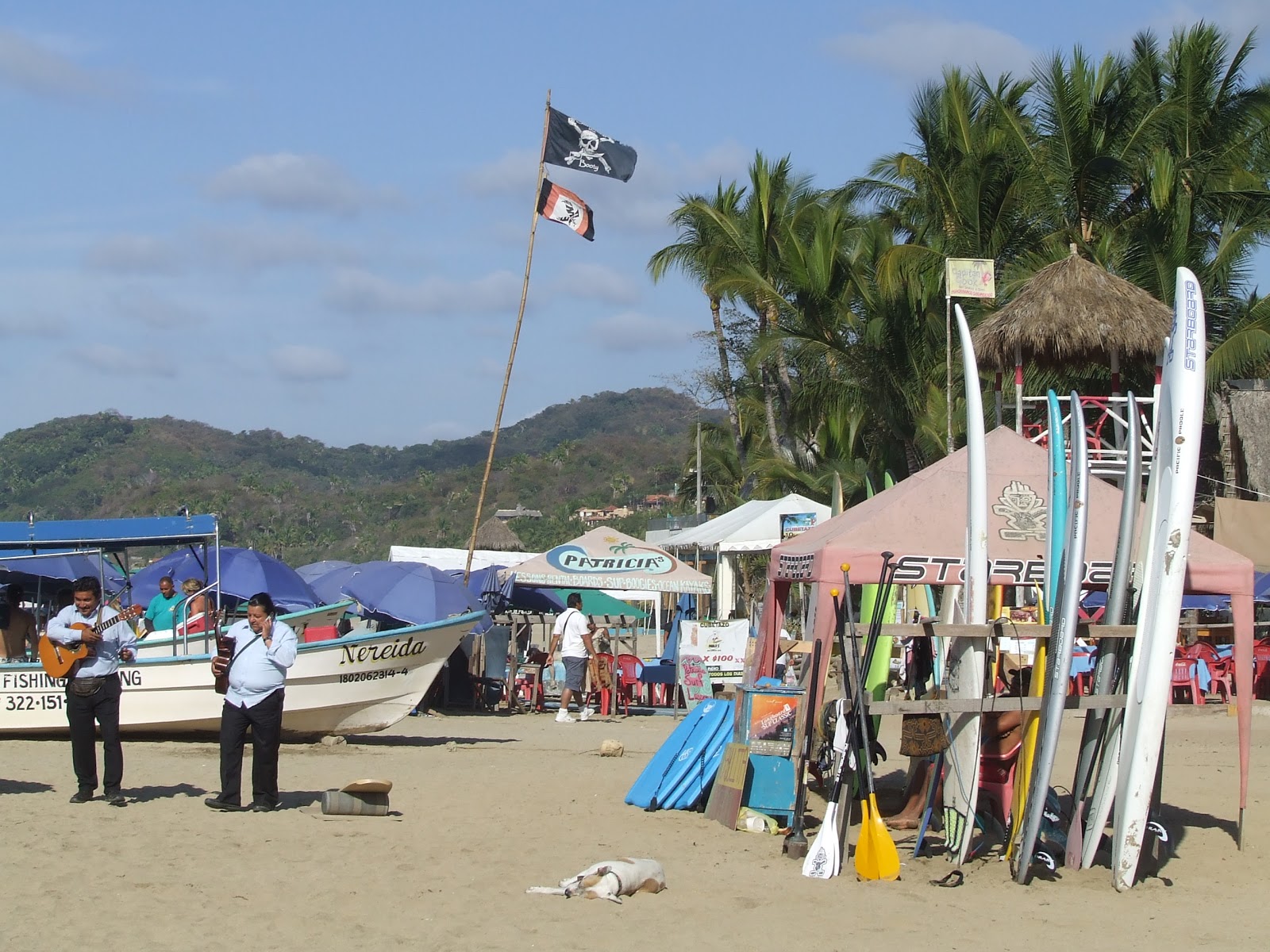
Sayulita, a town known as a surfer hangout. It is indeed a hangout for those taking surfing lessons:

Mariachis Serenading Pirate Surfers

Come On Baby, Surfin' Safari

In addition to surfers, the town was full of tourists, including those of the backpacker variety – we are sure we saw our former selves walking toward us on more than one occasion!

Our more adult selves took a trip to the Puerto Vallarta Botanical Gardens, which is home to a number of lovely gardens:


Cactus Garden

Agave / Cactus Garden
Viva la Bouganvilla!
 
Water Lillies

The Botanical Gardens also offers several short jungle hikes:  


A Walk To The River
The Great Explorer!
 We highly recommend a trip to the Botanical Gardens if you're visiting Puerto Vallarta. 

* * * * *

But, of course, no matter how much we enjoyed La Cruz it finally came time to leave. Why? Well, because we’re not just living on Abracadabra, we're travelling on Abracadabra. So we’re now 100 miles to the south of La Cruz in Bahia Tenacatita – we'll report in on THAT journey in our next posting.