Showing posts with label Chacala. Show all posts

Wednesday, February 6, 2013

Mazatlán to La Cruz de Haunacaxtle Including Visits to “Mexico’s Galapagos Island” and Ensenada Chacala – January 25 – 31

This 175+/- mile journey was our third between Mazatlán and La Cruz de Haunacaxtle.  We first sailed south-eastbound on our own in December 2011, and returned north-westbound with crewmate Bob Romano in March 2012.  On this passage we were joined by Toronto sailor Jim Thompson.  Jim also acted as "guest photographer".  [Note: You may recall Jim as our guest crew and photographer during our week tour of the islands off of La Paz in April 2012.]

But as anyone who has looked out of the car or train window on a commute home from work and thought “I don’t remember that . . .” knows – every journey is unique.  This is particularly true for sailors, as each passage has different winds, swells, weather, anchoring conditions and, sometimes, new harbors. 

Southeast From Mazatlán

The El Cid Hotel Marina in Mazatlán is such a convivial place that we spent most of the morning of the 25th saying good-bye to people and promising to see them “down south”.  Crew from Dolphin Tales and Tarry-A-Bit tossed lines to us as we departed. 

We had a first whale sighting as we motor sailed out beyond the islands at the north end of Bahia de Puerto Viejo.  Old Mazatlán was hidden in the haze.  Mazatlán may be a bit down-in-the-heel as tourist destinations go, but it is still a wonderful place to visit and we will miss the city and all it has to offer. 

We were able to sail around 13.00 and in the evening the winds came up and we began to roll in swells that were in the 2 meter (6 foot) range.  Around 03.00 we had to crank on the motor because the winds dropped below 5 knots.  We have learned that below 6 knots of wind is pretty much Abracadabra’s  “no go zone”. 


Jim Says: I Came to Mexico to Sail in the Sun, Not Motor In the Cold!

Parque Nacional Isla Isabel (“Mexico’s Galapagos Island”)

Isla Isabel is an island with both national park (Parque Nacional Isla Isabel) and world heritage site status located about 18 miles off the mainland coast and some 93 miles southeast of Mazatlán.  It is the home to rookeries for blue-footed boobies and frigate birds, a handful of fishermen and, from time-to-time, some research scientists and students. 

The island also has two rock-strewn anchorages, both well-known as places where it is easy to lose an anchor.  Because of this reputation, conventional wisdom has it that the island should be visited only in calm conditions.  On prior trips we hadn’t had optimum island visiting conditions, but this time as we approached the island we had very calm conditions – as in “not-enough-wind-to-sail” conditions.  We decided that this, plus the fact that we had the luxury of a third crew member, meant we should take the opportunity to stop at Isla Isabel.  

We approached the island at dawn, and soon saw that we were not the only sailors that thought this was the right time to visit.  The larger anchorage to the east of the island had at least seven boats in it, and we were unable to find anchoring room in water that was less than 40 feet deep.  The smaller, shallower, but more rock-strewn anchorage to the south of the island was empty.  Hmmm.  We all agreed that if we anchored in this anchorage we were not likely to sleep soundly.  We concluded that we would make the island a day stop and sail to our next destination overnight (which is where the luxury of having an extra person to stand night watches comes in handy!). 

Land Ho!  Isla Isabel at Dawn.
Abracadabra at Anchor - Isla Isabel.

We anchored at about 09.30 and rowed ashore to visit the island birds.  We had heard about the island and its bird population from many sailors and from guide books – but we still were not prepared for the amazing number of birds that we were able to see up close.  The hardest part of our visit was keeping an eye out for nests so that we wouldn’t inadvertently disturb a family-in-progress.

We saw frigate birds - including males in full mating display and new chicks:

The Handsomest Frigate Bird On The Island.

So What Are YOU Looking At? She Said.
Proof That Not ALL (Frigate) Babies Are Cute.
Frigate Bird In Flight (courtesy Jim Thompson).

. . . blue-footed boobies doing their mating walk and sitting on eggs:

You Can Tell By The Way That I Walk That I'm A Woman's Man . . . 

Blue Feet Protecting The Next Generatioin.
A Study in Blue.
. . . other critters:

Pelicans.
Lizards.

And Tourists.

. . . and the fishing fleet’s camp and shrine:

Fish Camp - Isla Isabel.
Fish Camp Scene.

Fishermen's Shrine.

After our tour of the rookeries, we ate and set sail again at dusk. 

Ensenada Chacala: 

Our 55-mile trip to the bay (bahia) or cove (ensenada) at Chacala took us about 15 hours during which we had winds varying from 12 knots from the northwest to 2 knots from the south-southwest, and a sea state varying from rolling to not at all.  It was smorgasbord night along the Pacific coast of Mexico.  We arrived in Bahia Chacala as the boat that was in the “queen’s spot” (right in front of the village) was departing.  We waited patiently for the crew to raise their stern and bow anchors and motor off.  We moved in and dropped anchor around 10.00.  Because Bahia Chacala gets a wraparound swell, most crews put out a stern anchor to keep the boat’s bow into the swells.  Explanation: riding up and down is better than rolling side-to-side.  


Abracadabra At Anchor in Bahia Chacala.
Bryce and Jim set the stern anchor (a process that involves rowing a dinghy with an anchor in it to the stern of the boat, dropping it, setting it and rowing the anchor rode back to be attached to Abracadabra’s stern).  Yes another good thing about having a third crew member – Molly was able to stay behind and make lunch and dig beer out of the fridge!    

Bahia Chacala has a beautiful white sand beach that is about half a mile long.  Along the beach are a number of “palapa restaurants” (outdoor restaurants with thatched roofs) and a couple of small hotels.  At the south end of the beach is a tiny luxury hotel that operates yoga and meditation retreats.  In town are rustic bungalows for rent to the budget-minded traveler, and some luxury homes for the traveler with a larger budget mind.  Among our favorite stops in Chacala is the coffee shop that sells home-made ice cream and the tapas bar on the beach – that now has more than an outside grill and a cooler used to chill the wine! 

Tapas Bar - Chacala.
We spent four days at Bahia Chacala rigidly adhering to the same rigorous daily schedule: breakfast on deck under the sun shade listening to the village roosters, a dinghy row to shore, a walk either along the beach or through the village, a lunch of fish and/or shrimp or tapas, a walk through some other part of the village or the beach (perhaps to purchase a coffee, or ice cream or fruit), a row back to Abracadabra, a swim, a cool shower and a drink, a dinner of grilled whatever-came-out-of-the-refrigerator, a free music show from one of the palapa restaurants, and finally sleep periodically interrupted by the barking of the village dogs (which became less charming as our stay neared its end). 


Colorful Chacala Native.
Worn out by this hectic life, we departed Bahia Chacala for Bahia Banderas, home to the famous resort town of Puerto Vallarta and, to the north of PV, one of our favorite places – the village of La Cruz de Huanacaxtle.     

Whale Watching Tour into La Cruz:

The 43 miles from Bahia Chacala to La Cruz was not much of a sail (at 3 knots of wind Abracadabra just bobs around) but was a terrific whale watching tour.  We had sightings every twenty minutes or so from 08.00 to 10.30.  Around 11.30, Jim was at the wheel and called out, “Uh, guys, I think I need to turn us – now.”  There was a whale less than 20 feet in front of the bow!  Jim put some 30 degrees on, and between the whale’s disinclination to be near our motoring boat and this turn, no one was injured.  This was officially our closest encounter with a whale!  

Whales were not our only visitors.  At around 10.00 we were visited by a hitchhiking teenaged blue-footed boobie! 


Hitchhiking Teenager.
We were afraid the bird was too young to travel so close to the big city of PV where he might fall into evil city ways and that it would be better for him to leave Abracadabra nearer to his home.  He was not impressed when we flapped our arms and said things like “shoo” and “go home”, so Jim took up the boat hook and approached him menacingly.  “Goooooo hoooome.”  The brave boobie stood his ground for a long time, but finally began to back slowly, slowly, until he toppled over the starboard rail.  He took flight before he hit the water, and off he went – we hope – to his home. We’re sorry we missed pictures of Jim jousting with the little fella.  

As we turned into Banderas Bay we got another wonderful welcome – wind!  We sailed the last two hours of the day, and docked at Muelle 9 (a queen dock compared to the one we were on last year) in time for a shower and a huge rib dinner and too many beers at Philo’s Bar and Grill.

More about our time in La Cruz in our next installment.

Monday, March 26, 2012

The Road to Mazatlan – March 9 – 18

La Cruz to Jaltemba (March 9/10)

At 10.30 we departed Muelle 4, B8 at the Marina Nayarit in La Cruz fully provisioned and with able crew imported from Spokane especially for the passage (our friend Bob Romano).  Molly nattered on about how we would return next year so she wouldn’t cry at the idea of leaving what, so far, has been her favorite place.  Winds were light so we motored and took advantage of the motor-generated electricity to make water.  And then we motored some more . . . this is what’s referred to in Mexico as “motor sailing” (motoring with sail up to give some stability to the boat; read: boring but necessary).  We had only one hour of true sailing all day. 
At about 18.00, after an uneventful and noisy voyage, we arrived at Bahia Jaltemba, prepared to be enchanted.  We were not.  Jaltemba is a big, open bay with much more development on shore than we were expecting.  The apparent lack of protection from the winds prompted us to tuck in behind Isla la Pena in the company of a smelly fishing boat and (apparently) abandoned panga, surrounded by scummy water. 

We took a vote and decided our stay in Jaltemba would be a one-night event.
Then, as if to apologize for the day of motoring and the less than charming anchorage, the fishing boat departed and the scummy water cleared up immediately.  To say the skies parted and the sun shown is to go a bit far – but it was a noticeable improvement in fortune and our spirits were greatly improved.  Dinner and a beer helped, too. 

Chacala – The Best Place?  (March 10 – 14)
The next morning, we were entertained by signs of life on Isla la Pena.  We watched as they prepared the island restaurant for weekend tourists by dragging out tables and umbrellas, waiving hands, shouting, etc..  Life in Bahia Jaltemba began to appear more promising than it had originally, but not enough for us to rescind our unanimous agreement to press on to Ensenada Chacala.  Chacala is only eight nautical miles from Jaltemba, so we agreed that if it did not pan out we could consider returning for the night. 

We arrived in Chacala after a three hour tour, most of it under sail, ready to enjoy the bay, and this time were not disappointed.  We set a stern anchor as recommended by neighbors and the cruising guide, and surveyed the area.  We were enchanted.
And perhaps one of the nicest features of Chacala is a very sheltered dinghy landing beach, so we didn’t have to frighten Bob with our sophomore dinghy landing skills right off the bat.

The next morning, we were greeted by our neighbor Mike from Dejala.  He told us that he and his mate Marie had arranged for a tour of some nearby petroglyphs the next day, and we agreed to join them.  This trip was one of the highlights of our time in this lovely place. 


Our guide Armando was obviously interested in the petroglyphs, and avoided what for us is the ultimate kiss of tourist-guide-death: pretending to know more than he knew.  He would show a petroglyph, ans say “it could mean this; a local curandero (Mexican Spanish for shaman) that I talked to says it means that; I like the idea that it means [whichever]”.   


Most touching of all were the signs that the location is still a spiritual place for many.


Chacala has the palapa (a thatched roof structure without walls) restaurants that one sees all over the Mexican coast.


But in addition, there were two retreat centers at the far end of the beach.  One is a yoga retreat, which we have on our list as a place for a “vacation” from sailing in the future.  The other has a tapas bar that consists of some chairs and tables set in the middle of a clearing where food heated on a grate over a wood fire.  We spent a lovely afternoon there one day, after Molly had done a very sandy swim to shore (beach waves stronger than she) and Bob did a more graceful swim back to the boat.
We extended our stay in Chacala by several days because it was so pleasant, but eventually had to decide to either (a) stay there forever (which when we found the guy that made homemade ice cream became a distinct possibility for el Capitan) or (b) go on to Ensenada de Matanchen.   

Matanchen Redux (March 14 – 17)
We left Chacala with regret at 11.00, but our spirits immediately picked up -- this was the sail we had come to Mexico for!  We made between 4.8 and 6 knots all day with winds on our beam permitting us to fetch our destination (i.e., sail on course).  None of this “do we motor to our destination or sail 45 degrees to one side of it then turn and sail 45 degrees to the other side of it?” stuff for us – we were on the direct bus.  Why were we so fortunate?  Because the sea gods love us, we presume.   

We arrived in Matanchen and set anchor at 15.30.  The bay was full of boats we knew from other marinas or anchorages so we anticipated a fun party.  Not so, as they were all planning on leaving the next morning early, purportedly to catch good weather (was it something we said?).  Left on our own, we relaxed on board and talked about what a great sail we’d just had.  And then we began to slap at the jejenes (in Canadian, “no seeums”) and took refuge below.    
The next day we travelled into town after running the banana bread gauntlet (Matanchen and San Blas are famous for their banana bread and there are dozens of little stands between the boat and the taxi stand).  We bought a few pieces on that trip.  San Blas had not inspired us the last time we were there, and this time it also appeared tattered and dusty.  But, as during our previous visit, our check-in with the port captain was efficient and we had a good lunch.  This visit we also took time to tour the local tourist spots – an 18th century Spanish fort and accounting house on a hill top overlooking the ocean,


and the ruins of an 18th/19thcentury cathedral (the inspiration for, as every tells you, Longfellow’s The Bells of San Blas). 


The excitement at the fort was the assault on the place by a group of recently graduated nurses on a trip to celebrate their accomplishment.  They were charming in their enthusiasm and startlingly young (or perhaps we are startlingly old?). 
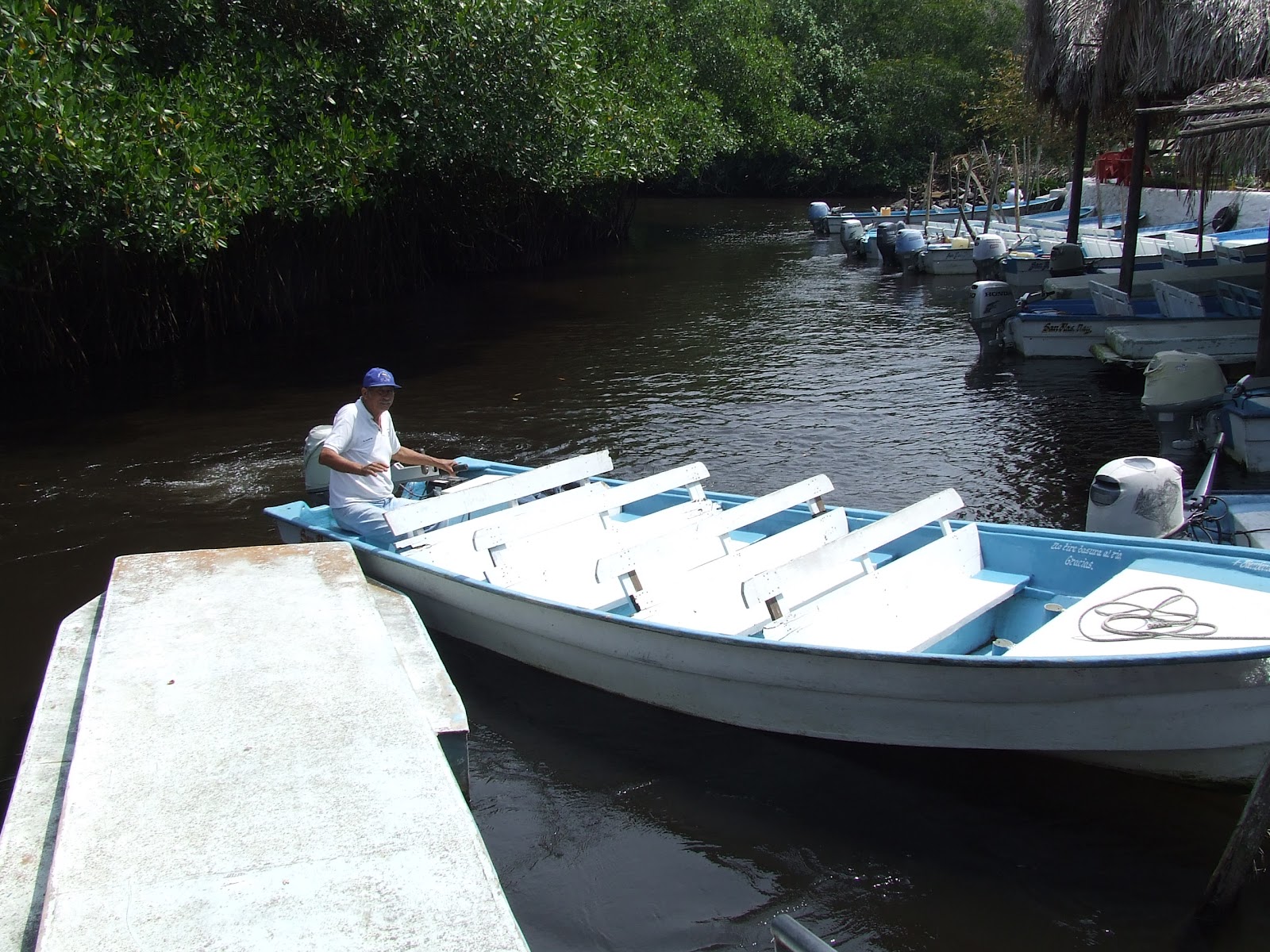
On our way back to the boat we succumbed to the banana bread gauntlet and bought a loaf from one of the many little panaderias (bread stores) along the highway.  After devouring the banana bread for breakfast the next day we performed the other requisite act of tourism required of visitors to Matanchen – a “La Tovara Jungle Tour”.  Bryce and I had dismissed the trip during our last visit thinking that we had “been there done that” a couple of times before in various places in Mexico.  But since then we had heard several times that this was a worthwhile trip, so we gave it a try.  So the intrepid threesome: Bryce, Molly and "Jungle Bob" . . .


went into the estuary of La Tovara with our guide, Jesus . . .


who, despite having a fairly alarming cough, perservered in pointing out the local wildlife . . .


and was a master at getting us In close to our photo subjects.


And who should come roaring up behind us but the graduate nurses we had met the day before in San Blas?

We got a good laugh out of the fact that we had spent the day sedately putting along the estuary taking pictures of birds, and these kids were screaming like they were on a Disneyland Ride.  Yes – life is better with every year.

The mid-point of the "jungle tour" was a stop at a swimming hole, carefully screened off from the local cocodrilo (crocodile) population.  We took a refreshing dip


and chatted with some sailors from Canada.  We have begun to wonder if anyone is at home in Canada during the winter? 
After returning from our tour, on the walk along banana-bread row, we bought so much food (banana muffins, sweet cornbread, empanadas, etc.) at the little panaderia we had visited the day before that Bryce felt compelled to try and explain that we were not gluttons, but were provisioning for the next couple days’ sailing trip.  The little lady in charge of the shop was much more interested in showing us her calculations, because of the huge price she was asking (something like $8 . . . ). 
St. Paddy’s Day Sail (March 17 – 18)

We left Matanchen on St. Paddy’s Day with very un-holiday like efficiency.  Anchor up at 06.35.  Ugh.  No winds, so we motored northward until the winds picked up and we were able to sail around 12.30.
El Capitan celebrated St. Paddy’s Day with the Wearin’ o the Green and the drinkin’ o a beer (with the squeezin' o the lime). 


The crew, too frightened of the tyrant captain to be caught sleeping on watch, were abstemious. 

The sea gods were with us for most of the day, and we sailed until 18.00 when the winds dropped.   Night watch with three people on two-hour watches was much nicer than with two people and three-hour watches, so we enjoyed the evening, though most of it was spent motoring.  We had a lot of company – several sailboats were heading into Mazatlan – so there was a lot to watch and a lot of radio chatter to keep us awake.  We arrived a bit too early for the marina to assign us a slip, but finally tied up around 09.15 with a gorgeous view of the channel dredging equipment and a chilly wind coming right into our cabin.  Welcome to sunny Mexico.  Bryce exerted his Canadian charm and got us a nicer berth a few days later! 


We’ll post about our time in Mazatlan soon!