Showing posts with label Boobies. Show all posts

Tuesday, March 12, 2013

“The Rime of the Ancient Mariners” or “Boobie Go Home” – March 5 - 12, 2013


WARNING: This post may not be appropriate for small children and bird lovers.
About dusk, on March 5, we were sailing briskly along on our way from La Cruz to Bahia Tenacatita.  Bryce was on watch.  We had successfully rounded Cabo Corrientes, and had just put a reef in each sail for the night, as the winds had risen steadily over the previous hour to between 17 and 20 knots.  Molly was below heating up dinner.  All was well in our little watery world.
A brown boobie approached Abracadabra.  Birds often fly near as we are sailing, and Bryce didn’t think much of this bird’s approach until it swooped down and clipped the backstay with its wing!  The bird staggered through the air, and almost ran into Bryce, who yelled “Holy crap, that bird almost hit me!” (or something to that effect).

The bird circled around, and approached again.  Bryce waved his arms in an attempt to create a visual reference, hoping to keep the bird from again running into the boat.  Molly came out of the cabin to find the Captain hopping up and down, flapping his arms and yelling something eloquent, such as “Shoo Bird!”  The bird did fly away from Abracadabra, but then returned, approaching from the port side.  This time it flew into Abracadabra’s rigging – lodging its head between the shrouds at the lower port spreader. 
To explain this bird’s location to non-sailors:  Shrouds and spreaders are part of the “rigging” that, in very simple terms, acts to stabilize the tall, otherwise wobbly, mast which rises about 48 feet above the deck.  Shrouds are metal cables that run from the top of the mast to the deck of the boat – one on the port side, and one on the starboard.  On Abracadabra these shrouds are connected to the mast in two places by metal braces called spreaders which extend perpendicular from the mast.  The first set of spreaders is about 15 feet above Abracadabra’s deck.  As the shrouds rise from the first spreader to the second, they create a little metal “v” – and that’s where the bird’s head was stuck.

At first we laughed, thinking this looked a lot like a curious little boy getting his head stuck between stair rails.  And then we realized that the stupid bird was well and truly stuck.  It was hanging -- and slowly strangling itself on the spreader!  We watched for a moment, horrified, hoping that the bird could save itself.  It spread its wings, and was able to remain aloft which released some of the pressure on its neck, but it couldn’t get enough lift to rise up and free its head from the “v” of the shrouds.  Its yellow feet (this was not a blue-footed boobie) flapped through the air, trying to get onto the shroud to leverage its head out of the vice it was in.  But it’s legs were too short.  It became rather gruesome to watch.
Struggling Boobie

Bryce grabbed the boat hook, and duct-taped a rod onto it.  He couldn’t reach the bird.  He sat on the boom, and still couldn’t reach the bird.  Finally, he stood on the boom and could reach the bird, but to no avail.  The bird was too heavy to lift with this jury-rigged contraption.  All the stick was doing was causing the poor, trapped bird additional aggravation.  Remember that this is happening on a moving platform in the middle of a lot of water.  Molly began to think it was time to give up on the bird.  Better a dead boobie than an overboard Captain.    

On more than one occasion the bird sagged, and seemed to hang by its neck until dead.  Each time, just as we would decide that all was lost it would revive, spread its wings, and struggle.  But as our recue attempts failed, we began to think the bird was doomed, and we were doomed to have it strangling away all night, and rotting away over our heads during the next several days . . . gruesome on both accounts. 
We each wondered whether a dead boobie in the rigging was like shooting an albatross.  Would we be forever cursed to motor without wind?  Would our water maker break leaving us with “nary a drop to drink”?  Would we be doomed to stop people on their way to weddings to tell them with our boring brown boobie story? 

We broke through this horrible flash-back to middle-school English class and realized that we needed some sort of platform to put under the boobie’s feet.  But what?  “We need a bucket!” the Captain cried.  “Bring me a bucket!”
In an act of selfless sacrifice Abracadabra’s laundress (that would be Molly) donated the largest bucket on board – the laundry bucket – to the cause.  An aside - the laundress unswervingly keeps this bucket separate and apart from the other buckets aboard because they are often filled with yucky boat stuff.
 
The Captain swiftly attached the bucket to the topping lift (for non-sailors this is a rope that runs up through the mast and out the top, back to the back of the boom, where it is attached to lift the boom) and raised the bucket up to the boobie.  The bird flapped a lot, not understanding our good intentions, but its big yellow feet were finally captured inside the bucket and, as the bucket was lifted tight to the spreader, the bird was able to stand in it.  The bucket was shallow enough to permit the bird to raise its head out of the metal “v” in which it was stuck – and, mercifully, it flew away.

Tah-dah!  The happy crew of Abracadabra began the “we just saved the boobie” dance!!!
And then we realized that the bucket was . . . swinging . . . and swooping . . . wrapping the topping lift around . . . and around . . . the mast and the top of the main sail.  High above us our rescue bucket had become a wildly swinging projectile.  In our excitement to create a rescue vehicle we had forgotten to attach a control line to the bucket!  We realized that, unless it came down on its own, we had no way of bringing the bucket down.  And of course, because this is when this sort of thing always happens, it was getting dark.          

We stood watching the bucket swirl around us in the darkening sky like an inanimate circus performer.  Our hearts sunk.  We were worried and we felt very, very stupid.  Finally, we took the only course of action available to us – we raised the bucket to the top of the mast, to prevent it from fouling up the sails, and sailed on.  The next afternoon we proudly rode into Bahia Tenacatita with our bucket proudly aloft!
Ignominious Bucket


On Friday night we join in the Bahia Tenacatita Mayor’s Raft-up.  The raft-up is a twenty-something year long tradition in Bahia Tenacatita where the “mayor” (we’re not sure how someone becomes “mayor” – but it probably has something to do with agreeing to organize the weekly raft-up) anchors his or her dinghy near the shore, and the crews of the other boats in the bay tie their dinghies to the mayor’s anchor rope.  Food is passed from dinghy to dinghy, and adult beverages are consumed.  Used books are traded.  Stories and swapped.  It’s a floating cocktail party. 
As the various dinghies were gathering Bob from Viva turned to Bryce and asked “So, what’s with the bucket?”  Bryce suggested that because more than one yatista might wonder about the bucket that we save the story for later, when all were gathered.  [Frankly, the story wasn’t yet funny to us – we were pretty humiliated by unsailorly-like bucket stuck to the top of the mast.] 

When it came time to share a story with the group, we told the story of the bucket and the boobie.  It was well received.  Everyone had a very good laugh – and mostly at the boobie’s expense!  Bryce explained that he was waiting for the stability of being at a dock before going up the mast to retrieve the bucket.  And then our friend Dick from Full and By explained that he had climbed boats at anchor on more than one occasion and had no qualms about rising 50 feet off the water tied to a rocking mast to retrieve a laundry bucket.  So, apparently, he’s a little crazy – but all to our advantage! 
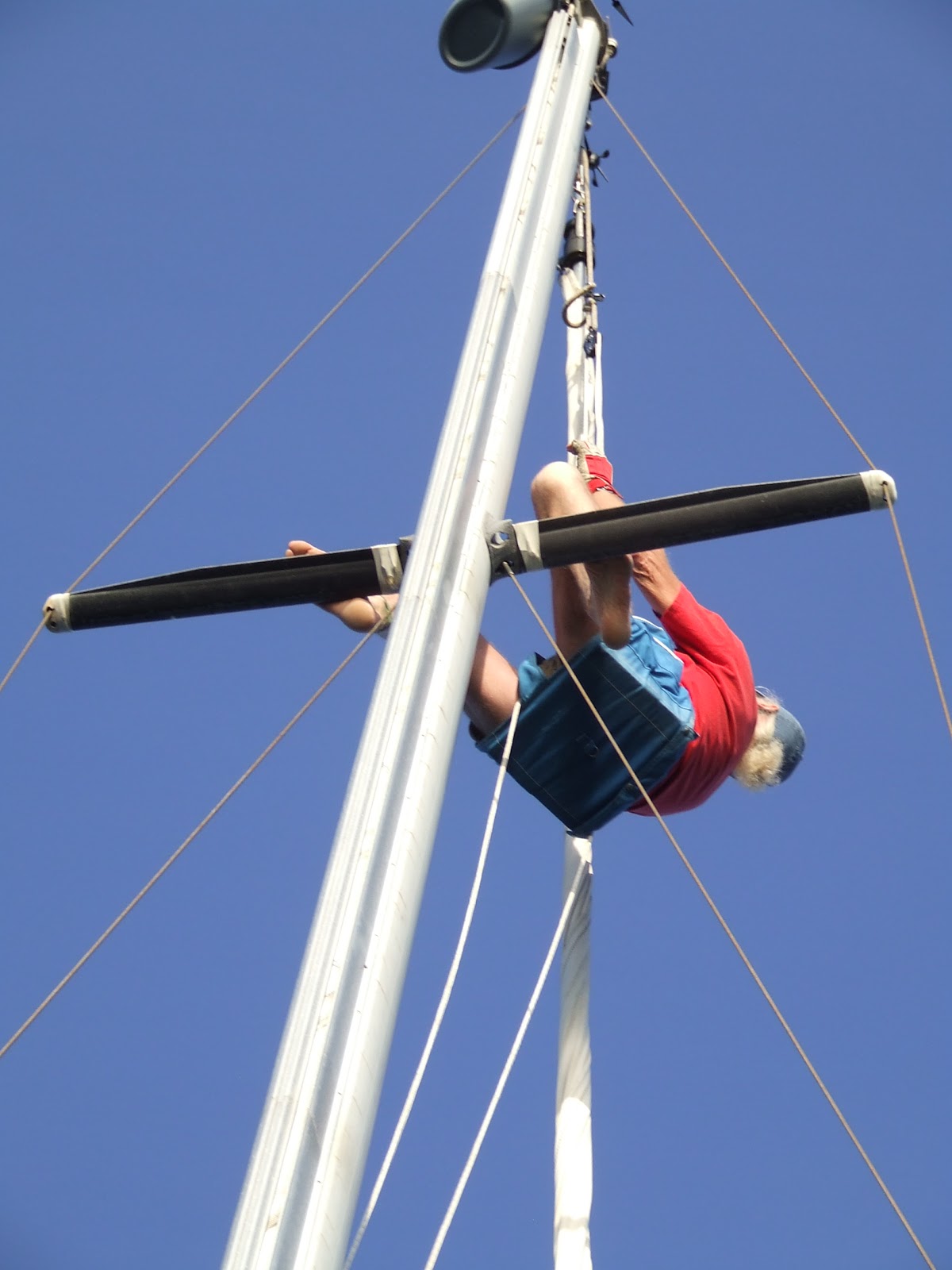
On Sunday morning at around 08.30, while the water was relatively calm – Dick arrived with his climbing gear, climbed the mast, and rescued the bucket!  And more importantly for his wife Anne, Dick returned to the deck in one un-squashed piece. 

Great Bucket Rescue

Spiderman on Abracadabra

Laudry Can Now Be Done

And thus the story ends happily.  No boobies, buckets or sailors were harmed.  And we are saved from a lifetime of reliving the fate of the ancient mariner! 

We are departing Bahia Tenacatita this morning for destinations (not much) further south, and will post about (hopefully) less exciting adventures soon.    

Wednesday, February 6, 2013

Mazatlán to La Cruz de Haunacaxtle Including Visits to “Mexico’s Galapagos Island” and Ensenada Chacala – January 25 – 31

This 175+/- mile journey was our third between Mazatlán and La Cruz de Haunacaxtle.  We first sailed south-eastbound on our own in December 2011, and returned north-westbound with crewmate Bob Romano in March 2012.  On this passage we were joined by Toronto sailor Jim Thompson.  Jim also acted as "guest photographer".  [Note: You may recall Jim as our guest crew and photographer during our week tour of the islands off of La Paz in April 2012.]

But as anyone who has looked out of the car or train window on a commute home from work and thought “I don’t remember that . . .” knows – every journey is unique.  This is particularly true for sailors, as each passage has different winds, swells, weather, anchoring conditions and, sometimes, new harbors. 

Southeast From Mazatlán

The El Cid Hotel Marina in Mazatlán is such a convivial place that we spent most of the morning of the 25th saying good-bye to people and promising to see them “down south”.  Crew from Dolphin Tales and Tarry-A-Bit tossed lines to us as we departed. 

We had a first whale sighting as we motor sailed out beyond the islands at the north end of Bahia de Puerto Viejo.  Old Mazatlán was hidden in the haze.  Mazatlán may be a bit down-in-the-heel as tourist destinations go, but it is still a wonderful place to visit and we will miss the city and all it has to offer. 

We were able to sail around 13.00 and in the evening the winds came up and we began to roll in swells that were in the 2 meter (6 foot) range.  Around 03.00 we had to crank on the motor because the winds dropped below 5 knots.  We have learned that below 6 knots of wind is pretty much Abracadabra’s  “no go zone”. 


Jim Says: I Came to Mexico to Sail in the Sun, Not Motor In the Cold!

Parque Nacional Isla Isabel (“Mexico’s Galapagos Island”)

Isla Isabel is an island with both national park (Parque Nacional Isla Isabel) and world heritage site status located about 18 miles off the mainland coast and some 93 miles southeast of Mazatlán.  It is the home to rookeries for blue-footed boobies and frigate birds, a handful of fishermen and, from time-to-time, some research scientists and students. 

The island also has two rock-strewn anchorages, both well-known as places where it is easy to lose an anchor.  Because of this reputation, conventional wisdom has it that the island should be visited only in calm conditions.  On prior trips we hadn’t had optimum island visiting conditions, but this time as we approached the island we had very calm conditions – as in “not-enough-wind-to-sail” conditions.  We decided that this, plus the fact that we had the luxury of a third crew member, meant we should take the opportunity to stop at Isla Isabel.  

We approached the island at dawn, and soon saw that we were not the only sailors that thought this was the right time to visit.  The larger anchorage to the east of the island had at least seven boats in it, and we were unable to find anchoring room in water that was less than 40 feet deep.  The smaller, shallower, but more rock-strewn anchorage to the south of the island was empty.  Hmmm.  We all agreed that if we anchored in this anchorage we were not likely to sleep soundly.  We concluded that we would make the island a day stop and sail to our next destination overnight (which is where the luxury of having an extra person to stand night watches comes in handy!). 

Land Ho!  Isla Isabel at Dawn.
Abracadabra at Anchor - Isla Isabel.

We anchored at about 09.30 and rowed ashore to visit the island birds.  We had heard about the island and its bird population from many sailors and from guide books – but we still were not prepared for the amazing number of birds that we were able to see up close.  The hardest part of our visit was keeping an eye out for nests so that we wouldn’t inadvertently disturb a family-in-progress.

We saw frigate birds - including males in full mating display and new chicks:

The Handsomest Frigate Bird On The Island.

So What Are YOU Looking At? She Said.
Proof That Not ALL (Frigate) Babies Are Cute.
Frigate Bird In Flight (courtesy Jim Thompson).

. . . blue-footed boobies doing their mating walk and sitting on eggs:

You Can Tell By The Way That I Walk That I'm A Woman's Man . . . 

Blue Feet Protecting The Next Generatioin.
A Study in Blue.
. . . other critters:

Pelicans.
Lizards.

And Tourists.

. . . and the fishing fleet’s camp and shrine:

Fish Camp - Isla Isabel.
Fish Camp Scene.

Fishermen's Shrine.

After our tour of the rookeries, we ate and set sail again at dusk. 

Ensenada Chacala: 

Our 55-mile trip to the bay (bahia) or cove (ensenada) at Chacala took us about 15 hours during which we had winds varying from 12 knots from the northwest to 2 knots from the south-southwest, and a sea state varying from rolling to not at all.  It was smorgasbord night along the Pacific coast of Mexico.  We arrived in Bahia Chacala as the boat that was in the “queen’s spot” (right in front of the village) was departing.  We waited patiently for the crew to raise their stern and bow anchors and motor off.  We moved in and dropped anchor around 10.00.  Because Bahia Chacala gets a wraparound swell, most crews put out a stern anchor to keep the boat’s bow into the swells.  Explanation: riding up and down is better than rolling side-to-side.  


Abracadabra At Anchor in Bahia Chacala.
Bryce and Jim set the stern anchor (a process that involves rowing a dinghy with an anchor in it to the stern of the boat, dropping it, setting it and rowing the anchor rode back to be attached to Abracadabra’s stern).  Yes another good thing about having a third crew member – Molly was able to stay behind and make lunch and dig beer out of the fridge!    

Bahia Chacala has a beautiful white sand beach that is about half a mile long.  Along the beach are a number of “palapa restaurants” (outdoor restaurants with thatched roofs) and a couple of small hotels.  At the south end of the beach is a tiny luxury hotel that operates yoga and meditation retreats.  In town are rustic bungalows for rent to the budget-minded traveler, and some luxury homes for the traveler with a larger budget mind.  Among our favorite stops in Chacala is the coffee shop that sells home-made ice cream and the tapas bar on the beach – that now has more than an outside grill and a cooler used to chill the wine! 

Tapas Bar - Chacala.
We spent four days at Bahia Chacala rigidly adhering to the same rigorous daily schedule: breakfast on deck under the sun shade listening to the village roosters, a dinghy row to shore, a walk either along the beach or through the village, a lunch of fish and/or shrimp or tapas, a walk through some other part of the village or the beach (perhaps to purchase a coffee, or ice cream or fruit), a row back to Abracadabra, a swim, a cool shower and a drink, a dinner of grilled whatever-came-out-of-the-refrigerator, a free music show from one of the palapa restaurants, and finally sleep periodically interrupted by the barking of the village dogs (which became less charming as our stay neared its end). 


Colorful Chacala Native.
Worn out by this hectic life, we departed Bahia Chacala for Bahia Banderas, home to the famous resort town of Puerto Vallarta and, to the north of PV, one of our favorite places – the village of La Cruz de Huanacaxtle.     

Whale Watching Tour into La Cruz:

The 43 miles from Bahia Chacala to La Cruz was not much of a sail (at 3 knots of wind Abracadabra just bobs around) but was a terrific whale watching tour.  We had sightings every twenty minutes or so from 08.00 to 10.30.  Around 11.30, Jim was at the wheel and called out, “Uh, guys, I think I need to turn us – now.”  There was a whale less than 20 feet in front of the bow!  Jim put some 30 degrees on, and between the whale’s disinclination to be near our motoring boat and this turn, no one was injured.  This was officially our closest encounter with a whale!  

Whales were not our only visitors.  At around 10.00 we were visited by a hitchhiking teenaged blue-footed boobie! 


Hitchhiking Teenager.
We were afraid the bird was too young to travel so close to the big city of PV where he might fall into evil city ways and that it would be better for him to leave Abracadabra nearer to his home.  He was not impressed when we flapped our arms and said things like “shoo” and “go home”, so Jim took up the boat hook and approached him menacingly.  “Goooooo hoooome.”  The brave boobie stood his ground for a long time, but finally began to back slowly, slowly, until he toppled over the starboard rail.  He took flight before he hit the water, and off he went – we hope – to his home. We’re sorry we missed pictures of Jim jousting with the little fella.  

As we turned into Banderas Bay we got another wonderful welcome – wind!  We sailed the last two hours of the day, and docked at Muelle 9 (a queen dock compared to the one we were on last year) in time for a shower and a huge rib dinner and too many beers at Philo’s Bar and Grill.

More about our time in La Cruz in our next installment.