Showing posts with label Costa Rica. Show all posts

Monday, February 6, 2017

Shakin’ It Down At El Rincon, Golfo Dulce –- February, 2017


We have returned from our four day “shake-down cruise” to El Rincon (The Corner), a cove at the northwest corner (hence the name) of Costa Rica’s Golfo Dulce. Our trip was a success in every way – including the identification of a problem (or, in biz-speak: a challenge) that we want to address before we depart for Panama.

More on that later. First:


Enjoyment Factor - High

This little trip reminded us of how much we enjoy sailing and being at anchor in a calm, relatively secluded location.


A Nice Corner Of The World

The wind wasn’t great or consistent, but it drifted above seven knots for short periods and we were able to sail . . . a veces (sometimes) . . . on our way to and from El Rincon.

The cove was very calm and we anchored near shore in 50’ of water (a bit deep for us, but as good as it gets at El Rincon).

Parrots, scarlet macaws, howler monkeys, crickets, neighborhood dogs and the bass speaker from a far away restaurant provided background music. Now and again the exotic, sweet smell of a ylang ylang tree would perfume the air. 

We swam and read books and waved at tourists who stopped to take Abracadabra’s picture. A small cruise ship named Polar Star (clearly lost) anchored in the cove. Its passengers were taken to shore for an excursion. We became “charming backdrop” for their posts about their jungle vacation.

We ate dinners in the cockpit and discussed the fishing techniques used by the few small boats drifting around the cove.

We watched a fellow chip the paint off a small boat using a machete. Probably not OSHA or EPA approved.


And Those Paint Chips, Sir?

One afternoon we rowed the dinghy (see below for why we rowed) around the little cove. We explored the signs at what we thought was a fish farm and learned that it was, in fact, an oyster farm.


El Rincon Oyster Farm

As we peeked through the foliage on shore we were amazed to see the remains of an airplane - a fuselage, tail and, we think, part of a wing - visible in the jungle. A fairly large single engine airplane. There had to be a story. Bryce asked an elderly guy (you know, about our age) sitting on the beach whether we had seen an airplane on shore.
Yes, it’s an airplane.
Do you know the story of the airplane? Was there an accident?
No, no accident. They used to fly here. Sometimes even helicopters.
Clearly we would get nothing further from the taciturn chap, so we thanked him, wished him a good afternoon and rowed on. We contemplated the possibilities: who were “they” - an airline, the coast guard, a tour company (?); why would anyone attempt to land a plane on the narrow, heavily forested area between hills and sea; or had the plane been drug to that spot for disposal, and if so, why - ?

Freed by our lack of information we concluded we had seen a reminder of the wild and woolly drug-running days of the early 1980’s. Go ahead – we dare you to make up a better story!  


Skill Building – Medium

Anchoring had been easy, even in 50’ of water; weighing anchor - not so much. Apparently over our three nights drifting gently back and forth in response to the 10-foot tidal change and the occasional bits of breeze the anchor or chain or both had snagged on . . . something down there. Ahhh - our first fouled anchor.

More adventurous sorts might have put on their diving gear and attempted to identify the problem. We don’t have any diving gear. We armed ourselves with patience.

We motored forward tentatively. We motored back. And again. Finally, Bryce was able to ease - bit by bit - the anchor chain and, finally, bring up the anchor itself. Un-fouling an anchor without dive gear: Check!

By the time the anchor was off the bottom Abracadabra was snugged cozily into the cove at an angle that suggested backing out would be a good idea. The last time Molly backed out of an anchorage was in 2011 and she’s happy to report she was able to do it again -- without backing into the nearby oyster farm. Loving that re-built engine!


Challenges Identified – Low

In case you haven’t already guessed, we were rowing the dinghy on our tour de cove because the dinghy outboard (aka the Suzuki Possessed By The Devil) did not perform as well as it might. We are told it needs more carburetor work. There have been so many nagging problems with this motor over the years that Bryce is now convinced it was manufactured on the Monday following the 2011 Super Bowl when all the workers were hung over.

Keeping on the sunny side of life: we now have an excuse to depart Golfito more slowly. Slowly enough for Bryce to tackle a couple of third tier projects like installing a cockpit shower. At anchor we were reminded how nice it would be to have a post-swim fresh water rinse in the cockpit. Maybe by our next anchorage we will.


That’s today’s story. More next time we have something to report!

Wednesday, February 1, 2017

Getting Things Together In Costa Rica -- January, 2017


No, we haven’t finished blogging about Spain but we also said we’d post about anything “exciting” in Golfito. “Exciting” may not be the word some would apply to our news, but it does excite us: We have reached the end of the Known* To-Do List and we are ready to take a test cruise!

               * A boat owner's "to-do list" can only momentarily be deemed complete . . . 

Today we received a national zarpe (permission to travel) from the Port Captain at Golfito and tomorrow we depart for a two or three night nautical tour of the Golfo Dulce (Sweet Gulf). During this mini expedition we will run Abracadabra's away-from-the-dock systems (e.g., engine, water maker and solar power) and revive the crew's away-from-the-dock skills (e.g., anchoring, water and power conservation, dinghy driving).


The Captain’s Known* To-Do List

               * See above

During this past month Bryce has been very busily whittling away at his boat projects. 

He has made great improvements to Abracadabra’s power system by:
  • Installing two new house batteries (after invaluable delivery assistance by the strong young battery luggers on the Banana Bay Marina staff!);
  • Installing a replacement solar panel (the bargain 50-watt panel died at the end of last season – perhaps not such a bargain after all); and
  • Designing a way to mount the two new 50-watt solar panels on the cockpit awning (these will be removed and stowed while underway).
That's 100 Watts Of Power, Baby!

Abracadabra now has solar output of 330 watts. 

Bryce has also contracted with Golfito-based experts to:
  • re-stitch and waterproof the canvas bimini and various canvas shade awnings (Golfito’s canvas guru, Adam);
  • reconfigure the back screen to accommodate a wind generator brace (Adam);
  • refinish the cockpit and salon tables -- they look like new (local woodworker guru, Rick, and his crew);
  • reinforce the salon cabin's somewhat squishy sole -- we no longer fear falling through into the bilge (Rick and crew); and
  • recharge the big fire extinguisher.
In addition to being a skilled woodworker Rick is an all-round boat guy so we hired him to climb the mast to install a new Windex (a wind direction indicator) . . .


Rick and Really Dead Old Windex

and do “whatever he could” to fix our long-broken wind speed meter and masthead lights. After some contact cleaner and a bit of clanging and banging the wind speed meter sprang to life! Hopefully this represents a full resurrection and not just a temporary reprieve!


We Have Wind!


The masthead lights are also working. Today. 

In addition to acting as contractor on these jobs Bryce has replaced the leaking raw water pump, the dysfunctional water system pressure pump and the dead as a door-nail macerator pump. He repaired the water heater and some water lines and valves (a dry boat is a happy boat); replaced the guts to the Magma grill (which only last about a year in the tropics); and installed two new portholes (on the dry boat theme).

Whew – a very busy start to 2017!


Other Stuff

Lest you think all work and no play has made Bryce a dull boy he also managed to complete a fairly complex 500-piece jig-saw puzzle:


Tom Thompson - Group of Seven

And what has Molly been doing? Keeping house and being charming - oh, and killing cockroaches (that seems to have been a successful effort).

Her mother would be proud.


House Keeping On Land
(We Moved Aboard January 23 And Swapped A Kitchen For A Galley)


And Next?

If all goes well on our shake-down cruise we will depart for Panama shortly thereafter - perhaps with winnings from the Golfito U.S. Veterans' Association Super Bowl Pool winnings in our pockets (ha). We’ll keep you posted on that.


[A Sad Aside: Sailing compadres have recently posted about the sinking of their boat, Siga-Siga, during a hurricane last September. They were kind enough to include some lessons learned during their insurance claim process. Worth noting in this blog is that during the insurance claims process they relied on their blog to document some of their boat improvements/repairs -- they had lost most of their repair/maintenance records when they lost Siga-Siga. We won't foist every repair/maintenance detail on you, but we find it interesting that this blog might – knock-on-wood – have a purpose in addition to communicating with friends and settling our marital travel memory disputes! And yes, the crew of Siga-Siga is searching for another sailboat.]

Wednesday, January 11, 2017

Costa Rica Living / Boat Projects – January, 2017

We can’t yet say we are ON Abracadabra but it IS accurate to say we are NEAR Abracadabra. Within about 100 yards, actually.


Return To The Tropics

We returned to Costa Rica on December 29 and stayed in San José for two nights. The idea was to “be on vacation” for a full day before we traveled on to Golfito and Abracadabra. You know, acclimate to the heat and hang by the pool.

Not so much.

Our one full day in the big city was spent at a down-at-the-heels shopping mall getting telephone chips (our previous local telephone numbers had expired), buying a tea kettle (even we couldn’t drink what came out of our old one), eating a very bad meal at a food court and getting Bryce’s hair cut (he hasn’t yet bonded with a barber in Golfito).

We flew to Golfito on Sansa Airlines on the 31st. [Explanatory Note: The following pictures were taken when we departed Golfito in August, but since we didn’t post about that trip and we didn’t get any pictures of our trip into town we thought we’d share these old pictures here.]


Golfito Airport Where Inside Is Outside

Ooops - But Don't Worry,
That Wasn't A Sansa Plane -- It Was The Police

Marina Pez Vela at Quepos From The Air -
Two Days To Sail It / 30 Minutes To Fly


New Year’s Eve

We arrived at our marina-side apartment in time to drop our bags and learn that (a) a giant papaya tree had fallen and taken out the electrical service on our side of the street and (b) there was a potluck party that night at the Cruiser's Clubhouse (a cruiser-friendly business run by Katie, the owner of the apartment we are renting). 

We walked to the grocery store and bought some chicken, chips and a bottle of white wine. We stashed our chicken and wine in the clubhouse fridge because that side of the street had power and returned to shower and dress in our finest wrinkled clothing. The electricity came on about the time we were leaving for the party. Yea!, we would come home to operating ceiling fans!

The party was a good “welcome home” for us. There were fireworks at various points around the little gulf (Golfito), our chicken was fine, the pot-luck portion of the meal was good and the crowd was very friendly and eclectic – Swedes, Canadians (both anglophone and francophone), Americans and an energetic Kyrgyz/Russian/Israeli. Someday Molly is going to write a novel and you will be able to meet some of the more colorful residents of the Golfito area!


Boat Related Stuff

Since the New Year began we have been living in the same nice one-bedroom apartment overlooking Banana Bay Marina that we rented for a couple of weeks last year. 


We Have The Top Floor - Great Breeze!
And a View of The Imperial Beer Sign.

From the comfort of home we make daily forays to clean and fix things aboard Abracadabra.  [Side Note: Many cruisers pride themselves in being hearty. The fact that we are not so much used to embarrass us. No longer. We are happy to work from a nice, breezy little apartment rather than sweat it out trying to live in a tiny construction site and are grateful that we have enough cash flow to do it this way!]

We were thrilled to find absolutely no mold and very little mildew aboard Abracadabra (remember, Golfito has the reputation of being the rainiest place in Costa Rica). We can’t recommend these little Eva-Dry de-humidifiers enough!


The Eva-Dry 1100!


They're about the size of a one cup coffee maker. We purchased two of them. Bryce drilled a hole in the drip tray of each and attached small draining tubes. One was left to drain into the galley sink, the other into the sink in the head. Those little guys sucked moisture for five months and were still at work when we arrived. $55.00 each plus shipping. Priceless.

Sadly, not everything has gone as well. As we began to clean Molly found two dead cucarachas (cockroaches) of the German variety (really – that’s the name for the gross little brown scampering guys). Good, we thought; they ate the bait we left for them and now they’re dead. Die, little bugs, die. We continued to clean shelves and drawers and then – dah, dah, dah, dum: Bryce opened a drawer and . . . a live one skittered. As all sailors know, there’s never just one cockroach. We have since squirted a full tube of Advion gel (we call it Roach Mega Death Gel) around the boat – in every nook and cranny we can find. This Roach Mega Death Gel was given to us by a Prince Among Men – the captain of a charter sport fishing boat named Derrick.  


We'll Get You My Pretties!


This stuff costs about $20 a box on The Evil Amazon and is very hard to find in Costa Rica. Our benefactor simply gave us a box and told us to pay it on. Assuming it works as well as it is reported to we will purchase enough to be able to pass some on to others in need the next time we see a Home Depot!

We’re also waiting for the delivery of:
  • replacement 4D-size AGM Lifeline batteries which are in route by sea from Miami (they weigh too much to be sent by air) because, well, 5 years in the tropics is a battery life well-lived; 
  • two electric pumps, one of which died a tragically young death; and
  • the original of our annual Coast Guard Declaration which is reported to be in the hands of Correo Costa Rica (the postal service).
These deliveries = we don’t expect to be going anywhere very fast until February. What are we saying! We’re traveling on a sailboat. Even when we’re going as fast as we can, we aren’t going anywhere very fast!


Golfito Life

As we wait, we suffer the hardships of Golfito with our usual charm and grace (that would be sarcasm):
  • We have eaten our way through the menu at the Banana Bay Marina which is the best restaurant in town - and as a result consumed more french fries in the last few days than in the previous few months!
  • Molly is going through mosquito acclimation which, if consistent with past practices should mean the local population will tire of her charms in a couple more weeks.
  • Bryce is learning what equipment may be flown in and what has to be shipped in (because nothing actually here is the right thing or the right size of the right thing).
  • Between 7:30 a.m. and about 10 pm we have to shout at each other in the living room because our apartment not only overlooks the marina – it overlooks the main coastal highway.
Garbage Day In Golfito

All of that is bearable - and sometimes comical - because we are also able to enjoy:

  • the vast space that is an entire one-bedroom apartment with a real shower, a flush toilet, a stand-up refrigerator, fans, an air-conditioner in the bedroom and big windows;
  • the company of our fellow cruisers and visitors (good to meet you Jeff and Laurie!), the assorted quirky expatriated Americans, Canadians and Europeans who call Golfito home and the charming people working at the marina and in local stores;
  • watching tourists - sport fishers and backpackers come and go;
  • and, of course, the views:

Cruise Ship Disappearing Around The Corner

Sunset - Golfito


We also enjoy watching the U.S. Coast Guard in action - well, in action at the Banana Bay Marina bar and restaurant anyway. There are two surveillance ships (we think they are 110' Island Class Cutters ??) that use Golfito for crew changes and fuel purchases. Molly mentioned to a fellow sailor that she got a lot of comfort knowing that potential rescuers were so close at hand. His suggestion was that if we ever did need to issue a distress call, we could assure a Coast Guard rapid response by announcing something like: "We are taking on water and our entire haul of marijuana is getting wet!" Ha! Point well taken. 

That's our Golfito life for now. More about where we’re going when we get ready to go there!


Our Next Post: We’ll return to blog entries on Spain unless something exciting happens in Golfito.

Tuesday, July 19, 2016

More Costa Rica by Sea (June 12–15) and Land (April 15-30), 2016


While Abracadabra is in the yard getting scraped, sanded, epoxied, primed and painted (sounds painful, no?) we have time to bring our blog up to date. In our last Costa Rica travel post we tried to connect a place we had visited during our land-based travels this past April with places we visited during our sailing trip along the coast in May and June. We’re not sure this geography-based narrative is all that coherent for readers but . . . once begun, we’ll see it through.

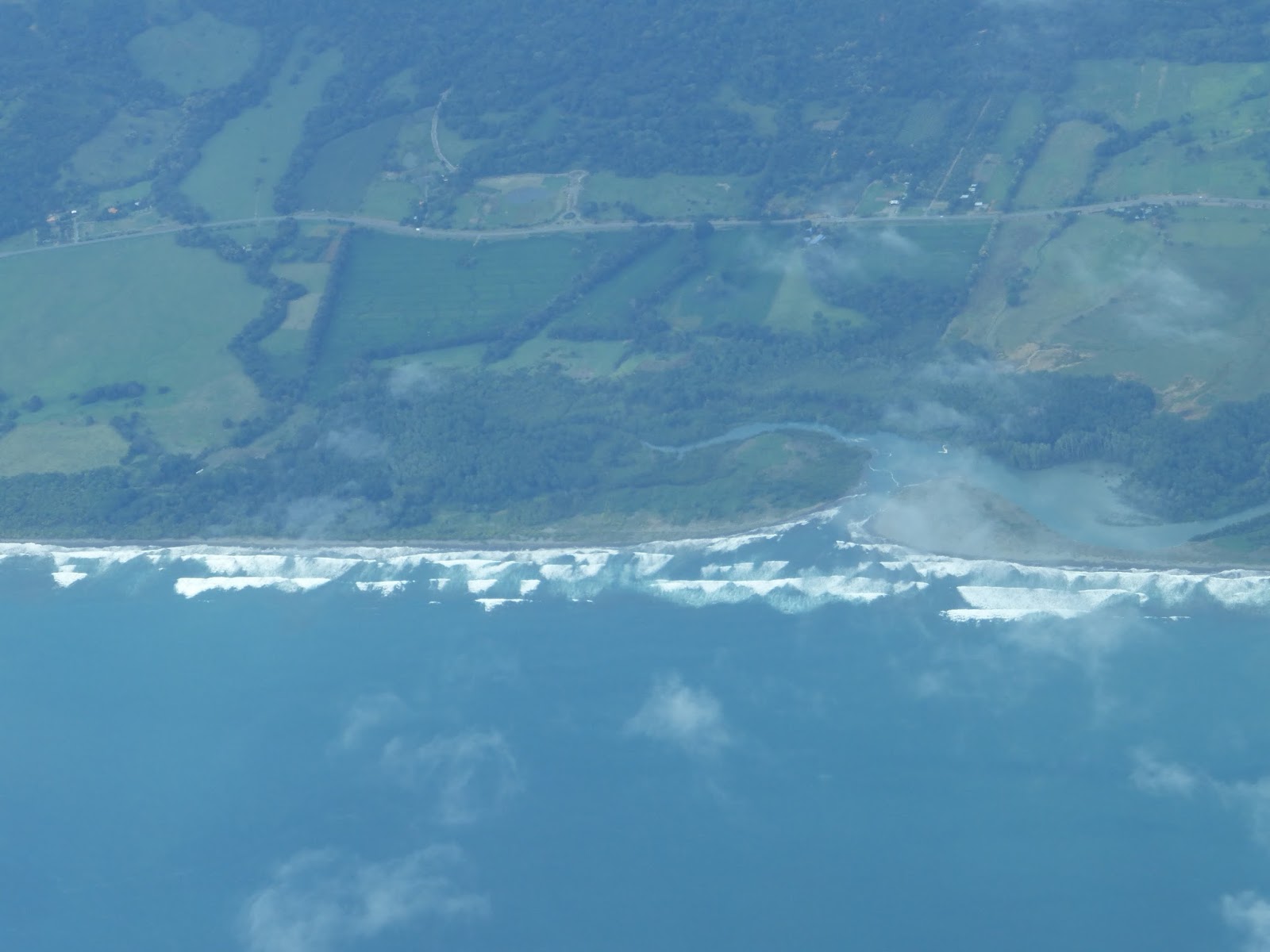
The picture below was taken along the coast of the Nicoya Peninsula but we have pasted it here rater than including it in context for the simple reason that Facebook shows the first picture of each of our posts and we really want everyone to see this great picture!


P1040304
At Least Twelve Shades of Grey

 
By Sea (June 12-15, 2016)


            Bahía Ballena (June 12 – 14):

Our trip around the bottom of the Nicoya Peninsula, from Bahía Sámara to Bahía Ballena (Whale Bay), was a nine hour motor. It began in flat, calm and dry conditions. 


P1040292
Anchor Up 05:45


A short time later we were in drizzle and rain with uncomfortable swells. 


P1040297
Soggy Captain

The rain/drizzle stopped in the afternoon, but there still was not enough wind to move Abracadabra along. As we rounded the entrance into the Golfo de Nicoya we entertained ourselves by trying to identify Montezuma, a beach town we had visited for two nights during our April driving trip. We think we spotted it and maybe even the casitas where we stayed, perched on the hill above town:


P1040318
Montezuma . . . We're Pretty Sure

As a transit anchorage Bahía Ballena is a good choice; well protected and calm. As a tourist anchorage – not so much.

Our neighbors included a ketch left on the hook quite some time ago and a lot of fishing boats. One of the fishing boats was quite large and . . . fishy.


P1040327
Sea Birds Waiting For Fish Cleaning Time


We decided not to go for a swim. 

The village near the anchorage looked a bit down at the heels and the funky bay-side bar/restaurant we had read about didn’t seem to be in operation. Even if it was open, we found its location immediately behind the busy fish loading/cleaning dock . . . uninviting. Hmmm ... and getting to town seemed to require (a) tying the dinghy to a “health-hazard dock” (muchos barnacles and broken concrete) or (b) a surf landing on a distant beach and a loooong beach walk. We dined Chez Abracadabra.  

We entertained ourselves by speculating about some aviation activity across the bay. On our first morning we watched a small plane on approach into the bay drop down and . . . dive into the jungle. A lack of smoke and fire suggested there must be a small airstrip hidden from our view. During the day we saw several planes swallowed up by the jungle but none take off. Over dinner we combined this activity with reports that Costa Rica doesn’t question wealthy foreign residents about the source of their income . . . and sketched out several bad but entertaining movie plots!


            Bahía Herradura (June 14-15):

We were happy to sail two of the five hours it took us to cross the Golfo de Nicoya to the anchorage at Bahía Herradura (Horseshoe Bay). Sailor Tip: Leaving Bahia Ballena we dodged several long lines that were marked only by small plastic bottles and we saw lots of debris as we crossed the golfo. It made our plan to day-hop down this coast rather than travel over night seem like a good one. But heads up if you come this way – whether you travel by day or by night.

Marina Los Sueños (loosely: Dreams Marina), one of Costa Rica’s expensive sport fishing marinas, is located in Bahía Herradura. We did not stay there and as far as we could tell there weren’t any sailboats there – only sport fishers. The anchorage across from the marina was comfortable but crowded with tourist lanchas and (more frugal) sport fishers. We were the only representatives of the cruising community.


P1040330
Horseshoe Bay

The next morning we decided to press on to our planned “splurge” stay in Quepos at Marina Pez Vela (yep, where we are now). After three weeks at anchor we were ready to treat ourselves to a couple of nights out, shore showers, unlimited electricity and water, a big grocery shop and an even bigger trip to a laundry.

We had sufficient wind from a sail-able direction for more than half the trip (about five and a half hours out of nine), which was a treat. At 15.30 we tied up to the gas dock at the marina, and after we checked in we were escorted by courteous marina staff to our home at Slip B-4 -- right in front of a restaurant serving the best pizza in Central America (Mercato del Porto)! Sailor Tip: Sport fishers tie stern-to. Staff at Costa Rica's marinas are more familiar with sport fishers than sailboats and may assume a stern-to tie when responding to your question of whether your slip is a port or starboard tie. Keep that in mind if your sailboat, like Abracadabra, doesn't back worth . . . uh, doesn't back well.

From Quepos south we didn’t/won’t sail past locations we visited during our April road trip, so this seems like a good time to segue back to that trip. We’ll return to our stay at Pez Vela and our sailing trip in our next post. For now, back in time to April:

By Land (April 15-27, 2016)

After a couple of days enjoying the beach resort thing at Playa Flamingo, we packed ourselves into the Costa Rica rental car agency SUV of choice (a Daihatsu Terios) and drove down the Pacific Coast of the Nicoya Peninsula to Montezuma. Travel Tip: The travel literature suggests using a 4-wheel drive for this trip during the rainy season. We recommend it any time of the year because the roads become brutal shortly after Playa Flamingo. Or you might, unlike yours truly, notice that the “suggested routes” in the tourist literature send drivers down the (more often paved) roads of the mainland and across to Montezuma by ferry from Puntarenas. Just an idea. 


            Montezuma (April 15 – 17)

We arrived in Montezuma happy to see the pool at Casitas Sollevante (“sol levante” = “rising sun” in Italian). This little mid-range hotel is very pleasantly landscaped and is perched on a hill overlooking the Golfo de Nicoya. Its bluff-top location makes for nice, breezy verandas most of the day; the hammock at our casita – heaven. But getting from the hotel into the town of Montezuma requires a drive down a long, bumpy and ill-lit road; venturing out at night requires drivers and passengers to trust in a beneficent cosmic force. Our group self-catered modest dinners on the veranda of our casita and visited restaurants for lunch. (Travel Tip: There didn’t seem to be many hotels that didn’t require an equally long, bumpy and ill-lit drive to get to the restaurants around Montezuma.)

We could hear howler monkeys in the nearby forest and heard and saw lots of birds - which for some of us made it sad that few of the windows in our little two-bedroom casita opened. Travelers who prefer ceiling fans and natural breezes for sleeping are pretty much out of luck there.

Montezuma was sleepy in April. We visited some nice restaurants and a good ice cream shop, but our guests found little in the way of cute tourist souvenir stuff shopping (those who live in 36-foot sailboats don’t often shop for souvenirs). There are lots of energetic activities available around Montezuma: zip-lines, scuba diving, ATVs, surfing lessons, bar hopping, etc. but it’s not the best location for short walk on the beach types.

We toured the Mariposario Montezuma (Montezuma Butterfly Farm) which is also home to the Butterfly Brewing Company for those who like exploring micro-breweries. We enjoyed talking to the young German girls who were volunteering at the mariposario almost as much as looking at the Blue Morpho butterflies they were helping to raise.


P1030918
Blue Morpho - Wings Closed


P1030929
Blue Morpho - Wings Opening


P1030922
Brenda and Susan on the
Blue Morpho Lookout


          Santa Elena / Monteverde (April 17 – 21)

From Montezuma we traveled to the mainland by ferry. The ferry, which docks in Puntarenas (from punta arenas - Sand Point) is inexpensive and efficient. It’s a great way to get across the Golfo de Nicoya, though not as nice as our sail across two months later!.


P1030934
Bryce Bringing Our Little Terios Aboard

P1030939
Brenda - Looking Nautical

We didn't stop in Puntarenas, but our brief drive-through convinced us to give the area a pass when we came across the golfo on Abracadabra. Puntarenas has a bit of a rough port town feel to it and the docks we saw were industrial looking. Fine for getting work done. Less fine for just hanging out.

It was easy driving for most of our way to the Santa Elena/Monteverde “cloud forest” area. Another Travel Tip: As one turns off the main highway to Santa Elena/Monteverde the roads get quite iffy again. See above re: renting a 4-wheel drive.

The bulk of the modestly priced hotels and the tour and transportation companies are in Santa Elena. The nearby village of Monteverde looks like it is mostly art galleries and a few restaurants. We checked into Hotel El Atardecer in Santa Elena. Our first night was very quiet but the next day it became clear that the hotel caters to bus tours. Of students. FYI, our four day study of student bus tours suggests that university students are quieter than middle-school children. Travel Tips: Costa Rica’s mid-range hotels often host large bus tours; go really cheap or expensive-spa-boutique and you may avoid them. Also, because Santa Elena is in the hills most of the hotels don’t have air-conditioning; heat-sensitive visitors might want to consider packing hiking boots and going in the rainy/muddy season.

Santa Elena and Monteverde are chockablock with tourists and it’s a bit overwhelmingly touristic for some. But the area offers many tour opportunities – even for people who don’t want to do the zip-line/water fall rappelling thing. We took a very fun and informative tour offered by the El Trapiche (The Press) coffee company. It combined information about the production of several Costa Rican products that require the use of a press:


P1030953
Cacao


P1030963
Sugar Cane
P1030984
Coffee

They also told us a bit about bananas (no press involved):


P1030959
Bananas

Another tour we really enjoyed was given by the Monteverde Cheese Factory, and not just because it included a cheese tasting at the end! The tour was given by a descendant of the original Quaker settlers of the Santa Elena/Monteverde area (see historical aside below) and was particularly appreciated by Brenda and Bryce, whose parents owned and operated what today would be called an artisanal cheese factory in Ontario, Canada. Sadly, the internet now shows that this tour is no longer in operation, though the cheese company recommends a tour company which may include information about the factory in its tour. 

Since our visit to the factory we have become loyal (and heavy) consumers of Monteverde cheese and recommend that, even if you can't take a tour of the factory, you consider trying Monteverde manchego -- it is likely to be available at the local Central American supermercado!

A Highly Condensed Historical Aside: Eleven Quaker (Society of Friends) families left the United States to avoid the draft in the 1950’s and settled in the Santa Elena/ Monteverde area. Costa Rica had abolished its army in 1948. In various places in Santa Elena and Monteverde there are pictures of the settlers bringing electricity and rudimentary roads to the then undeveloped and very remote area. One of the early settlers learned the art of cheese making in order to preserve some of the milk produced by the community’s dairy herds. The resulting cheese business has expanded and Monteverde cheese can now be purchased in several Central American countries. The Quaker community has also been instrumental in preserving a portion of the cloud forest.

We visited the fledgling Quaker History Museum to learn more about these early settlers and found that the museum has a very optimistic website and not much infrastructure. An enthusiastic young man walked us through the pictures and few artifacts there and we learned a bit about those early settlers. Maybe next year they will be in full operation . . .

Three of us toured the Santa Elena cloud forest preserve. We chose it over the more heavily visited Monteverde preserve to avoid large groups of hikers and because we had read that the greater percentage of secondary forest in the Santa Elena created wider sight-lines for visitors interested in seeing wildlife. We did avoid crowds and had only five people on our tour, but we didn’t have a big wildlife day. We enjoyed a great walk in the mist (read: cool) and our guide was very informative about the different plants we were seeing and the birds we were hearing.


P1040007
Brenda In The Forest

P1030993
Cloud + Forest = Cloud Forest


P1040003
Our Tour's French Contingent -- 
Taking a Picture of a Stuffed Animal To Share With 
Their Baby Who Was Staying At Home With Grandma


P1040012
A (Blue Crowned - ?) Motmot


One day Brenda and Susan decided to rest up from the rigors of tourist life, so we toured a couple of things on our own. We visited another butterfly farm, where we got a different recipe for making butterfly-attracting food (the fruit must be fermented, not raw, we were told) and saw a wide variety of butterflies (the names of which we do not now remember).


P1040022P1040023


We also toured the orchid garden behind the Orchid Garden Café (where we also had very good coffee and lunch). We were fascinated to see the zillions of different types of wild orchids,


IMG_20160421_110539_1

IMG_20160421_105842_1


some of which are spectacularly tiny:


IMG_20160421_111733_1


          Lake Arenal (April 21-25)

Our group's last stop was another popular location on the Costa Rica Tourist Trail -- Lake Arenal. It’s kind of an odd tourist destination because it was originally marketed as a place where tourists could watch the eruptions of the Arenal volcano . . . but then the volcano quit erupting in 2010. By that time a huge tourist infrastructure had been built up around the volcano so . . . tourists still flock to the area by the literal busload. Build it - and advertise it - and they WILL come. 

Present-day tourists can enjoy pretty views of a nice lake and the volcano. There are also opportunities for spotting the type of wildlife everyone comes to Costa Rica to see: howler monkeys and birds (which we heard and saw) sloths (which we didn’t) and coatis (which are really fast little buggers and hard to photograph).


P1040044
Hey - Stop! I Wanna Get A Picture . . . . 


There is also a big hot spring and mud bath business that has sprung up in the area - even dormant volcanoes create hot springs, apparently. Not being big on hot water bathing with large groups of strangers we can’t tell you anything about this tourist activity. 

And of course there are . . . zip-lines . . . lots of zip-lines!

Brenda treated us to a fishing trip on Lake Arenal arranged by our Airbnb host, Mairon. Susan and Mairon actually caught fish - though we don't think the guide will be boasting about their catches on his website. The rest of us fished briefly and unsuccessfully -- but enjoyed the ride on the lake.  


P1040030
Susan - The Most Successful
Fisherperson of the Day


We really enjoyed our volcano-viewing day. 


P1040042
Arenal

We opted to purchase a day pass at the Arenal Observatory Lodge. The $10 per person day passes (which they don't promote heavily on their website) gave us access to the lodge’s well-groomed grounds and several well maintained walking trails. We walked to a nearby waterfall and visited the hotel’s little museum. We also had a just fine lunch at the lodge's restaurant. 

There are other places to view the volcano, including the Arenal national park, but the lodge offered us the opportunity to view, lunch, view, walk, rest, view -- all at our own pace. 


P1040055
Bryce at the Waterfall
P1040062
Arenal Again
P1040059
Great Sibling Shot

The lodge's restaurant deck offers not only lovely views of the volcano - there are several bird feeders nearby which attracted several types of birds we hadn't seen before. Not being true birders, we didn't write down the names of those we saw . . . 


P1040067
Bird Of Unremembered Name - ?

 
We also spent a lot of time just enjoying Casa Isabelita, a nice house above the lake which we found via Airbnb. We could see and hear lots of animals (more howler monkeys) and birds (Susan got a picture of the elusive toucan). We had access to a lovely little community swimming pool. And we were able to make simple dinners “at home” (see above re: our group’s unwillingness to trust the roads of Costa Rica at night).


IMG_20160423_183844
Chef Brenda


We found some nice places for lunch nearby and can recommend The German Bakery in Nuevo Arenal and Cafe y Macademia near El Aguacate. There's also a nice tourist souvenir shop next to The German Bakery in Nuevo Arenal.


          Liberia (April 16-17)

Because Brenda and Susan were departing from the airport in Liberia (where about a month later we checked Abracadabra into Costa Rica) we spent their final night at the Hilton Garden Inn near the airport. It was a really pleasant splurge after a couple of weeks in the small rooms of mid-range hotels and self-catering cottages.

Once our guests had checked off the various departure boxes and were inside the airport security area we moved to the Best Western El Sitio in Liberia (just fine, though the pool was a weird green color) and walked into town. Liberia is not a big tourist destination but it does have a couple of blocks of pleasant “old town”.


P1040075
Liberia's Tiny Historic District
Has Some Pretty Old Buildings

We had lunch at the Cafe Liberia, which is in a lovely old building and offers very nice sandwiches at lunch. Don't believe any taxi driver that says it's not open for dinner, just FYI.

And Liberia isn't a bad place to get a haircut:


P1040080
A Complicated Cut 
Requires An Explanation . . . 

Road Trip Wrap Up

Before we return to Our Life Aquatic, here are some general thoughts about Costa Rica as a tourist destination (Sub-title: It’s Not Mexico, But That’s Okay):
  • Costa Rica is not a bargain travel destination. In particular tourist-class restaurants and the larger hotels are almost U.S. priced. We enjoyed the country a lot more once we got over worrying about that.
  • Most tourist services (food, tours, hotels, souvenirs) are quoted in U.S. dollars. Sometimes that means payment should be in U.S. dollars. But even when the final bill has been in dollars, we’ve sometimes gotten credit card receipts showing payment in colones. Other times the dollar price quote just means the business is anticipating the constant tourist refrain of: “What’s that in U.S. dollars?” and the bill will be in colones. We enjoyed the country a lot more once we gave up trying to win – or even understand -- the currency conversion game.
  • We had guides who spoke good English, were well educated on their subject (and sometimes well educated in general) and were willing and able to answer questions. From time-to-time in Mexico and other Central American countries we have found guides working from laminated tour notes who were unable/unwilling to speak off book. That’s not been a problem in Costa Rica. Reminder: Guides aren't highly paid and appreciate tips.
  • It’s a clean country -- really clean to those arriving from another Central American countries. And you can drink the tap water! But you still shouldn’t flush toilet paper.
  • The country’s main product is its bio-diversity and for the most part that product is well presented. But it’s sold relentlessly. It’s difficult to take a stroll to stretch your legs without paying $15+ per person to walk through a “reserve” (though many hotels have a "reserve" which is available to guests). 
  • OMG there are zip-lines everywhere.
  • Many of the tourist activities in Costa Rica are of the high-octane variety: zip lines, volcano climbing, waterfall rappelling, jet-skiing, etc. There are relatively few museums or pre-Hispanic ruins to tour. Culture vultures may be disappointed.
  • The Costa Rican people are extremely polite and kind. E.g., if you speak Spanish they will let you stumble along without interrupting and when they finally rescue you, it’s often in a very sweet way that suggests they appreciate your attempt. (I.e., they don't assume you are stupid, as they seemed to do in Honduras.)
  • The yatista buzz is that the country is rife with opportunistic theft -- little violent crime, but watch your wallet, cell phone and dinghy outboard. So far we have not encountered this. Knock wood.
  • The country’s typical cuisine is fine, but not exciting. Gallo pinto (a rice and beans dish) is healthy, hearty and tasty . . . the first five mornings it appears as part of the hotel's included breakfast. And the tourist restaurants all seem to have the same menu. But keep in mind there’s likely to be a Pops Ice Cream somewhere in town, which can make up for a lot (choco-almendras, trust us on this).
  • Don't buy coffee that's not labeled "for export" - the good stuff is exported. Small local restaurants can sometimes offer very bad coffee.
In sum: Costa Rica is a very easy place to travel independently. But we have discussed whether it might not be a good place to take a tour arranged through an educational organization or a tour company with an educational focus. It's easy to find tours that provide good information about the country's flora and fauna (every kid in town knows the term bio-diversity). But it's difficult to impossible to find a local tour guide who includes information about the country's history, art, architecture and culture in his (so far, it's always been "he") tour. In addition, paying for activities up front as part of a packaged tour might lessen the financial discomfort we began to feel after several days of paying $15-$30/+ per person per activity . . . and that's without ever riding a zip-line! Just some thoughts for your consideration.


Our next post: Marina Life.