After living in Mexico for the bulk of the last three years it sometimes doesn't feel all that "different" to us. But we have recently visited parts of country that make us feel like travelers again. Warning - we're pretty enthusiastic about our most recent inland trip, so this is a loooong post!
One of our visits was to the city of Oaxaca which we'll talk about in a "flashback" post. The most recent was to San Cristobal de Las Casas (pronounced: Chris-TOH-bahl) in the mountains of Chiapas. One of the reasons we're so enthusiastic about San Cristobal is its climate (average high temp in April is 74 degrees vs. 90 degrees at the coast)!
But there's much more to San Cristobal than wearing sweaters.
Getting There
The trip between Tapachula (the first class bus station nearest Marina Chiapas) and San Cristobal is 330 kilometers (220 miles) according to tourist agency charts. A more accurate measurement is that it's either a nine-and-a-half hour or a seven-and-a-half hour bus ride, depending on the route. The company that runs the first class service between Tapachula and San Cristobal is OCC, and it routes along either (a) the relatively poor roads following the often mountainous border with Guatamala or (b) the new, well-paved cuotas (toll roads) around Tuxtla Gutierrez (the state capital) and on to less well-paved but flat roads along the coast of Chiapas.
We traveled each route by accident because we chose our bus based on seat availability without any knowledge of the various routes (research, research, research). Note to self: take the cuota route next time - even at the huge additional expense of $5.50 USD! For those that want to see the countryside at the border, keep in mind that Dramamine might make that route more comfortable for certain tummy-sensitive travelers.
Before the bus left each station along each route OCC staff took a video of each rider. We didn't want to think about why they might need our picture . . . we just tried to look like ourselves in case either our relatives or the U.S. Government needed to confirm our identify.
Each trip included non-stop "entertainment" - mostly children's movies at high volume. Bring earplugs if you hope to sleep before midnight (when the movies mercifully were turned off). The seats reclined and there was a functioning restroom on board.
There were no restaurant stops. "Food" and "drink" (chips, cookies and sugary soft drinks) were offered for sale at each bus station by someone who brought a basket of zero nutrition on board. Note to self: take some real food along on the next bus trip.
The longer, winding border route included more military checkpoint stops than the cuota route. Each inspection included a walk-through by one soldier and a brief check of a few (apparently randomly chosen) carry-on bags. No checked baggage was searched. We guessed that this meant the check was for illegal immigrants rather than contraband.
And both rides got us where we were going within a half hour of the scheduled arrival time!
Being There
If you have ever been to Cusco, Kathmandu, or Ubud you will probably find San Cristobal de Las Casas familiar. It's a backpacker hangout with lots of opportunities to buy tchotchke from traditionally dressed women and children that from time-to-time engage in uncomfortably aggressive sales techniques. Molly finally bought some little tetra paks of chocolate milk to hand to sales-children when she said "no, gracias". It made her feel better about not buying things she didn't want.
This makes San Cristobal sound unpleasant - but if one can deal with the "rich outsider" guilt that such places often bring up it's a great place for a visit. There are lots of interesting museums, a fascinating culture to learn about, beautiful textiles and jewelry (not necessarily those sold on the street), lovely hotels, wonderful coffee houses, a great wine and tapas bar (La VIna de Bacco) and some good restaurants. And did we mention you get to wear sweaters there?
The Maya Influence
The Maya have tenaciously hung on to their language and many aspects of their culture despite almost 500 years of Spanish-culture domination. In San Cristobal one third of the population is indigenous - mostly of the Tzotzil and Tzetzal ethnic groups -- and a large portion of that population is bi-lingual (their native language and Spanish). Others are uni-lingual in their indigenous language.
We learned a little bit about this complex cultural group during our stay in San Cristobal by visiting local museums and some local villages that act, for outsiders, as living museums:
Museo de la Medicina Maya: One of the enduring legacies of the Maya is their use of plants for medicinal purposes. The Museum for Maya Medicine is not only a museum but a pharmacy
 |
| Bryce Buying Mosquito Deterrent |
 |
| Cures |
 |
| Drying Room |
and the home of the Organization of Indigenous Doctors.

Much in Maya medicine depends on the reading of the patient's pulse, which is what is taking place in the picture on the organization's sign.
The museum also has a fascinating video (dubbed in English if you ask) showing the traditional method of giving birth, which appears to be awkward in the extreme. The mother kneels, facing the father, who is seated in a chair. She clings to him and he holds her up while the midwife, who is behind the mother, places a cloth around the mother's middle and gently squeezes. The child is caught behind the mother by the midwife.
The midwife then cleans the baby and makes sure that his or her soul is protected from evil eye. The midwife also advises the mother on what to eat and not eat over the next several months. Avocado will apparently cause a male baby's penis to swell. No report on what it does to female babies.
Museo Na Bolom: This museum is the former house of archaeologist Frans Blom (originally Danish) and anthropologist Gertrude (Trudy) Blom (originally German). This fascinating couple settled in Chiapas and championed the Lacandon indigenous group, thought to be one of the most direct links to the ancient Maya. Their former house in now a research center, a hostel open to indigenous people traveling through San Cristobal de las Casas and archaeologists and anthropologists working in the area, and a hotel open to visitors to the area.
Na Bolom (Tzozil for "House of the Jaguar") is an interesting and lovely place:
 |
| Courtyard at Na Bolom |
 |
| Art in One of the Rooms at Na Bolom |
and had we known about it as a hotel, we would have considered staying there.
One of our memories of Na Bolom will be that while we were there the (almost daily) afternoon rain turned to hail!
 |
| Frozen Rain - A Novelty For The Crew of Abracadabra! |
Museo de Textiles del Mundo Maya: Another museum that introduced us to the Maya was a textile museum. It was a beautifully done museum. It included several videos showing the use of the traditional back-strap loom, and the textiles were arranged by type and location. Many of the pieces were attributed to the weaver, which is not always the case when the art of indigenous people is displayed.
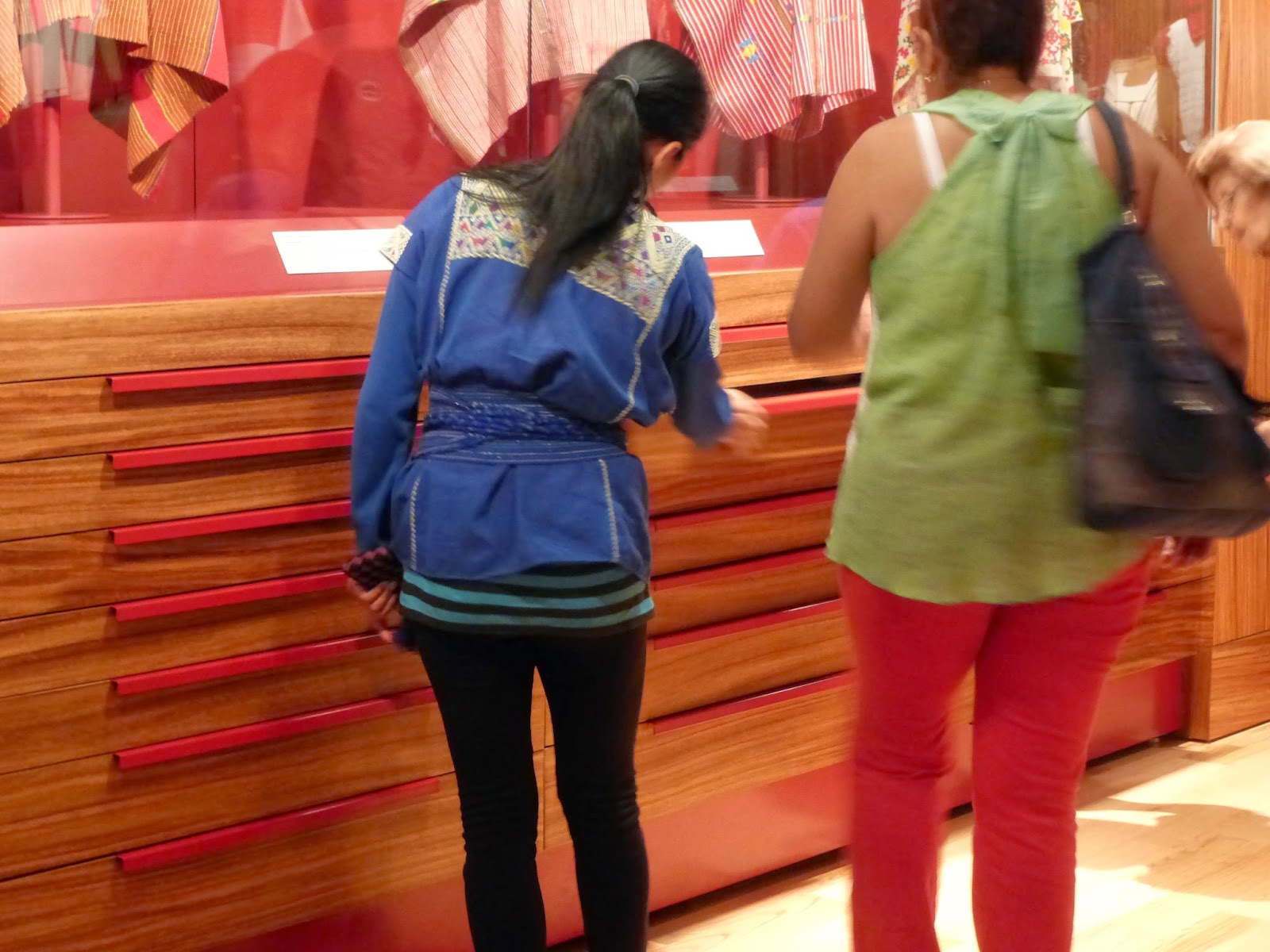 |
| Drawers To Protect Fragile Pieces |


After viewing the beautiful, handcrafted fabrics and clothing in the museum the prices of the beautiful handcrafted pieces in the adjacent shop are not so shocking. And the tourist items in the open air market on the streets surrounding the museum (likely not handcrafted) were put into perspective. Molly vows that someday when she has access to a table worthy of the handcrafted fabrics in the museum shop she'll return with her credit card!
Traditional Towns
We took a day trip to a couple of smaller towns nearby that are semi-autonomous political entities occupied and governed by the Tzotzil people. We toured with the Escudo Jaguar tour company and highly recommend the culturally-sensitive tour they provided.San Juan Chamula: Our first destination was the Tzotzil village of San Juan Chamula. San Juan Chamula is a communally farmed area that looks quite prosperous. Some of the houses are very large and well maintained, and the fields surrounding the town are quite lush.

San Juan Chamula - Religion: San Juan Chamula's place on the tourist map is due to the type of "Traditional Catholicism" practiced there. "Traditional Catholicism" is the term currently being used to refer to the blend of indigenous and Catholic traditions practiced by a large portion of the Maya in this area. In our very short observation the religion practiced in San Juan Chamula appears to be a blend of shamanism and Catholicism - heavy on the shamanism.
Taking pictures is prohibited in the local traditional catholic church. Visitors are warned that their cameras are subject to confiscation if they violate this prohibition.
 |
| The Outside of the Church at San Juan Chamula |
So here is our attempt to paint a word picture of what we saw:
The church is dark and filled with the eye-stinging fragrant smoke of burning copal (a resin incense). The floor is covered with pine needles (and somewhat slippery as a result), the smell of which mingles with the smell of copal. It's very crowded, but there are no pews; everyone is either standing or kneeling.
Around the sides of the church are statutes of various Catholic saints, all of which are inside boxes with glass covers. The saints' garments have mirrors on them. We are told that this is to catch the sunlight when they are paraded around town on festival days. The saints are segregated - male saints on one wall, mostly female on the other.
At the front of the church, behind what would be the alter in a "Rule of God Catholic Church" (as some refer to the church overseen by the Pope) is a statue of St. John the Baptist. The only statue of Jesus is to his right hand. We were told that the local population revers the Baptist over Jesus of Nazareth.
Around the church are various groups of worshipers, all kneeling before various numbers and colors of candles on the floor. Some have grouped their candles before a particular saint-in-the-box. We are told that the number and colors of candles relate to what the shaman has determined is necessary to achieve the worshiper's needs; curing an ailment, warding off the evil eye, or preparing for a birth; these seem to be among the primary purposes for visits to the church.
 |
| Color and Size of Candles Are Significant |
From time-to-time someone will drizzle a "holy drink" among the candles. This drink is usually posh, a beverage distilled from sugar cane (which doesn't taste nearly as good a rum) or Coca-Cola. Coca-Cola is apparently less expensive to use than posh and thus a popular "holy drink". How the Coca-Cola company got the religious franchise in this area is unclear, but we heard the following amusing and plausible sounding story: A shaman was visiting San Cristobal de las Casas (the big city) one day in the 1950's and fell faint. Someone gave him a coca-cola to drink and it was so effective in reviving his spirit that he decided it was as good as posh as a holy drink. Sugar and caffeine - what's not holy about that?
Also on the floor are eggs. A curandero or curandera a (healing man or woman) often uses eggs as a diagnostic tool. He or she will rub the egg on the body of the patient. When the egg is cracked open the shaman is able to see things that diagnose the patient's problem or help prepare the patient for an upcoming birth, much like reading tea leaves.
On the day of our visit there were not just eggs - a chicken that was being dispatched in the interest of curing. We were told that, after being waved over the patent/worshiper, the diagnostic chicken would be cooked and eaten. This isn't simply a case of waste not, want not; the chicken helps to cure the very problem she was used to identify.
We appreciated the fact that our guide was vigilant about asking tourists that lingered too long to move away from the people engaged in religious activity. He reminded us that it's first a living community, and only then a living museum.
As we were preparing to leave a group of worshipers, lead by a religious leader (more information on that below) arrived, playing instruments and singing. They were led to the front of the church by the leader. We did not stay to watch them. None of the other worshipers seemed to pay them any heed.
And among all of this, about twice a month, comes a priest to hold a mass before the alter. That must be an interesting job.
Each saint-in-a-box is kept in good order (cleaned, clothes washed and pressed) by a male "religious leader" who, according to our guide, serves a one-year term. The MQs for the position are that he be married (proving the importance of women in the culture we were told), that he feel the call, and that he wait his term on the waiting list of men interested in a "religious leader" position. We forgot to ask if the application was saint-specific. The religious leaders are different than the shamans and curanderos, they serve in a more administrative capacity.
While serving, the religious leader lives in a house that includes a small one-room shrine. Pictures inside the shrine weren't permitted.
 |
| The Outside Path To The Religious Leader's House |
Our word picture: The room is small, and there are only two windows. It is overwhelmed by a large platform topped by greenery and surrounded by flowers. This is the platform on which the applicable saint statute will be placed and carried about town on festival days. In front of the platform copal is burning, and candles are also burning in animistic clay holders. There are plastic bottles of posh against one wall. The religious leader is not present - he does not meet with visitors that are not there for religious purposes. His cute daughter came in and out to stare at us occasionally.
During the religious leader's one year term he is given the right to run a store in which he sells posh and candles. This assists in meeting his costs of office - replacing flowers and greenery around the saint's platform, keeping the saint statute clean, and repairing and cleaning the saint's clothing.
 |
| The Former Church and Graveyard (White Crosses for Children; Black for Adults; Blue for Youths) |
San Juan Chamula - Clothing: The various Maya communities can be identified by their traditional clothing. Even in a traditional village like San Juan Chamula most of the young men wear the traditional garb of Mexico - jeans and t-shirts. But many of the women and some older men favor traditional dress. For women this includes a black wool skirt that, at the risk of being culturally insensitive looked to us a little like "fun fur" (Molly had a beige "fun fur" coat in high school -- which probably says more about her taste in clothing than the traditional clothing of San Juan Chamula). Apparently it takes ages to create one of these bulky, shaggy skirts.
Again, photos of individuals are frowned upon. So here's a photo of some dolls dressed in traditional Tzotzil dress:
 |
| Black Wool Skirt for Women; White Wool Tunic (Under the Serape) For Men |
 |
| Skirt On The Hoof |
San Juan Chamula - Government: San Juan Chamula has a unique autonomous status in Mexico. State and Federal officials have little control over the area, which is governed by a ruling body made up of and elected by male residents. Our guide explained that this male-voters-only idea is inconsistent with the Mexican Constitution, but is permitted in order to help preserve the Maya culture. He tried valiantly to justify this . . . but we just kept thinking of Japanese islanders clubbing baby seals. Some cultural practices deserve to be changed.
Again - no pictures of these individuals are permitted. Below Bryce poses next to a statute of a San Juan Chamula leader holding the staff of office and wearing the colorful hat worn during festivals. .
 |
| Men Men Men Men Men. . . |
 |
| San Juan Chamula's Main Square |
Sadly, the Traditional Catholics of San Juan Chamula, have not only excluded women from community governance, in the interest of preserving their cultural heritage they have been unwilling to allow freedom of religious expression within their jurisdiction. Several decades ago several thousand ethnic Tzotzils were exiled from San Juan Chamula because of their adherence to either "Word of God" Catholicism or Protestantism (Mormons and Pentecostals are active among the Maya). Because San Juan Chamula isn't just a religious community, but a communal farming community, the exiled were not just "excommunicated" religiously. They were economically disenfranchised. These exiles now live in or around San Cristoal de las Casas, many of them wearing their former community's traditional clothing and work in the itinerant retail trade.
So . . . our take-away from San Juan Chamula: San Juan Chamula is an interesting place, but aspects of the isolated culture are rigid and exclusionary. Perhaps the old saw "A nice place to visit, but we wouldn't want to live there . . ." applies for us. We also felt a little odd that the culture itself was such a tourist attraction. Visiting San Juan Chamula was much like going to Amish Country or the floating islands of Lake Titicaca in Peru. One wonders what it's like at home - do the women slip into jeans; do the men crack open a beer and talk about how it's so much better to drink while watching a futbol game than that posh stuff? We're outsiders - we'll never know.
Zinacantan: The next stop on our tour was Zinacantan, another Tzotzil community. Unlike San Juan Chamula photographs aren't just not prohibited - they're encouraged for a price.
 |
| Ten Pesos For A Picture |
The traditional clothing in Zinacantan is happier and prettier than that of San Juan Chamula. Everyone is decorated in beautiful flowers (see above). The economy in this town is also communal, but rather than growing produce, they grow flowers. There are miles of plastic greenhouses at the outskirts of town.
Flowers appear to be a better paying business than produce, as the houses in Zinacantan are, on the whole, larger and more colorful.
 |
| House in Zinacantan |
 |
| Another Zinacantan House |
Next to the church is a building that, from the outside looks like a second church, and from the inside looks like a meeting hall. In the center is a large wooden table, surrounded by chairs. This is the meeting place for the religious leaders of Zinacantan. On the wall is a Christmas light display that plays the same carol over and over and over.
In Zinacantan we visited the home of a local family, which doubled as their tourist boutique.
 |
| Colorful Wares For Sale Zinacantan |
The home was more than a point of sale. It was truly the family home, including the family's home shrine:
 |
| A Zinacantan Home Shrine |
We were shown a traditional method of cooking tortillas - which were delicious, very dense and corn flavored.
 |
| Delicious Tortillas |
Though we expect that the more frequently used kitchen is similar to those we've seen in other prosperous villages throughout Mexico - containing a small stove and refrigerator.
Our take-away of Zacantan is that it looked like a more relaxed and pleasant place to live than San Juan Chamula.
San Cristobal
Hotels: In addition to being a good place to learn a bit about the Maya, San Cristobal is lovely and interesting as a Spanish colonial town. It is the home to dozens of very nice hotels, including the two we stayed in - Hotel Diego de Mazariegos
 |
| Courtyard Hotel Diego de Mazariegos |
and Casa de Los Arcangeles. We found both on the internet and changed only when we decided to stay two additional nights and found that the Hotel Diego de Mazariegos didn't have any rooms available in our price range.
Sadly we are still working through a billing problem at the Casa de Los Arcangeles which didn't honor our prepayment through Hoteles.com. And early on our first morning there we learned that the restaurant kitchen was being remodeled . . . directly behind our headboard! So we'd recommend the Hotel Diego de Mazariegos over the Casa de Los Arcangeles. And if we don't get our double payment problem fixed through Hoteles.com we're going to become those grumpy internet complainers on Travelocity.
Mexico, 1989: In many ways San Cristobal struck us as the Mexico we once knew. Its side streets are full of hand-made things that the expanding Mexican middle class no longer purchases. They prefer and can afford new, machine-made items from Walmart.
 |
| Cooking Stoves Made From Recycled Cans |
 |
| Knives Need Sharpening? |
Coffee: Chiapas is famous for its coffee and San Cristobal is full of coffee houses, many of which have spectacular desserts to take with that delicious coffee (Captain Bryce's favorite is called "Oh, La La").
There's even a coffee museum - Museo del Cafe which became one of our favorite places for breakfast. It's not only a coffee house and museum that explains the history of coffee production in Chiapas (from foreign investment, to government ownership, to small private fincas) - it's a meeting place for coffee growers and buyers.
 |
| Business Meeting at the Museo del Cafe |
An interesting coffee fact from the museum: of the 283 growers in Chiapas, 200 are farms of less than two hectares. [If you're like us and have no idea what a hectare is - it's 2.47 acres.] So - very small farms.
Perhaps that's why there's a market for these small roasters made on a side-street in San Cristobal:
 |
| Hmmm . . . Can We Get One Aboard? |
Amber: The thing to buy in San Cristobal is amber. It's mined in Chiapas and it's lovely. And yes, there's a museum about that, too. Molly got a lovely pair of amber and silver earrings with matching pendant because she deserves them . . . and we couldn't afford to get the amber sunglasses on display at the museum.
 |
| How Glamorous Are These?! |
We didn't even get to the jade museum. Next time.
Music and Theater: Music was everywhere - because it's Mexico. There was a marimba band competition in the central square one night and we enjoyed watching people dance to the contestants' offerings. We went to a very techie production about Pakal, one of the leaders of the famous Maya site at Palenque. We didn't even get t Palenque, which is near the state of Yucatan. Just think how long this post would be if we had!
And because this post is long, we'll spare you discussions about the meals we enjoyed.
And because this post is long, we'll spare you discussions about the meals we enjoyed.
See You There?
Don't miss San Cristobal if you have any interest in the Maya or southern Mexico in general. If you go, you just might see us back there - drinking coffee and eating pastries at Oh, La La or sipping a great Mexican Temporanillo at La VIna de Bacco!


