Showing posts with label La Paz. Show all posts

Wednesday, January 16, 2013

2013 Begins: La Paz to Mazatlán – January 10 - 13

Our 230 mile crossing of the Gulfo de California from La Paz to Mazatlán was a very “full menu” journey.  We experienced calm seas with gentle breezes and 23 knot winds with 6 foot swells.  We motored, then worked at keeping the big genoa full and finally zipped along double reefed.  We saw a whale that saw us too and had a couple of spectacular dolphin sightings.  The nights were both starry and pitch black.  The sea packed a lot into 48 hours!  Alas, we have no pictures of our trip.  Perhaps some well-meaning friends should take up a collection and send one of us to remedial nature photography school?

The Calm. 
We departed Marina Palmira in La Paz at 08.30, motoring into a very tranquil sea.  We motored . . . and motored . . . and etc. down the Canal de San Lorenzo and north of Isla Ceralvo in breezes too light to keep the sails full.  The serrated edges of the Sierra Gigante mountains receded behind us.  To the north the sky was filled with wispy, geometric cloud designs that looked like brushed Chinese calligraphy characters.  We tried to find comfort in (rather than be annoyed by) the sound of our now-faithful diesel engine. 

After lunch we spotted Ever Glean, a pretty little green hulled sloop that had anchored near us in Agua Verde.  We talked briefly by radio, but they were sailing to Puerto Altata some 50 miles north of Mazatlán so we didn’t expect to hear anything further from them on this trip.  [note: foreshadowing!] 

Our first night started out very dark because the moon was new and there were lots of clouds.  It is disconcerting to motor into such darkness.  Even five knots feels fast when you can’t see where you are going – imagine driving in the pitch dark without headlights.  The brightly-lit Baja Ferry passed several miles from us.  A few stars peaked among the clouds near midnight.
Around 01.00 we were finally able to sail in soft, 8-9 knot breezes.  Each of us had a night watch visitation by dolphins swimming through boat-side phosphorescence (greenish sparkles in water created when microscopic critters called dinoflagellates are disturbed by the movement of a boat).  The dolphins rushed by underwater, outlined in the shiny green sparkles.  Bryce called them “x-ray dolphins”.  Abracadabra trailed phosphorescence most of the night, prompting Molly to think of Peter Pan flinging open the shutters and inviting the Darling children to fly away into a starry night.  Since our trip we’ve seen Life of Pi – see it for some great movie phosphorescence! 

On our second morning, the wind began to build and Bryce put one reef in the genoa.  Dawn spread orangishly rather than rising red, due to increasing cloud cover.  The sky was a virtual sampler of cloud designs: bunched up cotton balls; wispy; grey trailing smoke; big billowing – all manner of clouds.  We were out of sight of land.  Abracadabra sailed on in 12 to 13 knots, accompanied by the sound of the filling sails, the swish and gurgle of small swells, and the occasional static of the radio.  It was as if the sea gods were making up for almost 20 hours of motoring!

The Not So Calm. 
In the afternoon the winds reached the low ‘20s and the occasional swell topped 6 feet.  Abracadabra began to rock and roll.  Bryce double reefed both sails to gain better control and to avoid arriving in Mazatlán before daylight and high tide. 

As we began to prepare for a less than tranquil night, we heard a radio distress call from Ever Glean (remember Ever Glean?).  They had run aground - we think on the entrance bar at Puerto Altata.  We radioed that we were at least 10 hours away and couldn’t be of any assistance, but that we would attempt to relay their distress call.  Bryce put out a radio call and received no response.  We were too far from Mazatlan to be heard.  It was a horrible time, thinking of running aground in rough seas in a place where rescue involves something more complicated than an expensive call to Vessel Assist.  Fortunately within about 15 minutes we heard from Ever Glean that they had been pulled off by some pangueros and no longer needed assistance.  We will keep our eyes open for them as we travel south, and wish them the best.
When night came it was moonless, starless and really, really black.  Our only neighbors were a sailboat represented by a tiny red light far to our starboard and something represented by a tiny white light far to our stern.  It was cold and the ride was rough.  Night watch was spent holding on to avoid falling down.  Our greatest concern was not that Abracadabra would let us down, but that we’d wrench a shoulder or lose our grip and fall, arriving with an ignominiously broken or pulled fill-in-that-body-part!

In the grey of day (there was no real dawning – only a lightening of the clouds) we could see Mazatlán in the distance.  We were not going to arrive too early but we still had to enter the yacht harbor channel in 20+ winds and rough seas.  It was not an appealing prospect. 
Nature decided to divert our attention by putting on a show:  a juvenile humpback whale jumping out of the water perhaps a mile or more away in front of the rising sun.  He seemed to spot us, raced over, and began spy-hopping some 100 feet to our starboard side.  Spy-hopping is when a whale raises from the water and holds a position, much like when a human treads water, in order to observe something.  Something like Abracadabra.  He (she?) swam closer, each time rising and peering at Abracadabra, finally rising about 70 feet from our stern.  A few more full body jumps followed near our stern!  Apparently realizing we weren’t going to engage in any fun type of play, he departed -- of course before we had wits enough to grab the camera.  Then came dolphins, perhaps a hundred of them, racing along beside and past us - a real Gulfo de California welcoming committee.  

Welcome to Mazatlán.
A couple of hours later we started the engine as we approached the breakwater.  The swells were setting us for the breakwater and we dared not think about what would happen if our (now) trusty engine failed.  When Abracadabra cleared the breakwater the crew let out an audible sigh of relief and Captain Bryce announced in his best fake airline captain voice:  “Welcome to Mazatlán, Ladies and Gentlemen.” 

Inside the breakwater was a different world.  The wind was still high but the swell was gone and on the dock were friends from Calliope and Two Pieces of Eight waiting to catch our lines.  They had been monitoring the radio and had heard our approach chatter with the marina.  That evening Maureen and Ted from Tarry-A-Bit and Lynn and Debbie of Dolphin Tales shared some of their wine, listened politely to our passage story and brought us up to date on some of our other Mazatlán friends. 

It was the perfect welcome to Mazatlán.  Friends - as good as dolphins!


Monday, November 5, 2012

La Paused in La Paz


Life is easy in a nice marina – and Marina Palmira is a very nice marina: sturdy docks; water; power; clean showers laundry facilities; shuttle to town; small tienda/chandlery;  two dock-side restaurants and . . . . drum roll please: access to the nearby hotel’s swimming pool! 

La Paz itself is very easy to adapt to (see prior posts about its charms).  And now that we have a car, we find that we are less efficient – if we don’t remember to get X at the store – we can just go back tomorrow.  Thus we have succumbed to the local cruiser condition of being “La Paused”.
 
Not that we have been completely idle! Oh, no:

WE VOTED – AND WE HOPE YOU HAVE TOO:  And an expensive proposition it was.  Our mail-in ballots arrived at our San Francisco address after we departed for Mexico.  So, we had them forwarded, along with other mail, to us in La Paz via Federal Express.  Realizing that our ballots had to be received by November 6 to be counted (we had somehow thought they only needed to be mailed by November 6) we paid to have them sent by UPS to Sacramento where friends Ken and Claudia Carlson have placed them into the US Mail in a timely fashion.  Ken tells us that our package was apparently reviewed by the Office of Homeland Security – but that they didn’t open our ballots! 

We were willing to pay $35 dollars to get our ballots in on time (even though they will have little effect on California’s Electoral College vote) because this was Bryce’s first vote for President (he became a nuevo Americano in 2011)!  And there’s the psychological comfort of knowing that however tomorrow’s election and the subsequent litigation turns out – WE voted for the best candidates and the “right” policies.  Obama/Biden 2012! 

WE ARE PUTTING ABRACADABRA BACK INTO CRUISING FORM: We pulled the items
 stored in the salon and the V-berth (for non-sailors: the “living room” and the “bedroom”) and have been putting them back on.  On went the sails, the dingy hoist, the outboard motor for the dingy, the cockpit table (aka the breakfast nook), the safety equipment, the bar-b-que, the new anchor chain and the anchor.  Into little storage places went the new salt, sugar, paper towels and rice.  We installed the bimini (the shade at the stern) and, with the help of our neighbor Robert, the solar panels.  It had been a year since Bryce and Frank designed and built the solar panel braces. . . so it took a bit of head scratching to figure out how to put them back together.   

 Hmmmm - now how was it this thing worked?
Note to selves: don’t throw away installation instructions, and if it’s something self-manufactured . . . make a note – a year is a long time between installations!

WE CELEBRATED DIA DE MUERTOSMolly attended a lecture at a Spanish language school about the Day of the Dead and learned that, though the celebration has its roots in pre-Hispanic tradition, the current form of the celebration dates from the 18th century.  There are actually two days during which the dead are honored – the first day (November 1 – Todos los Santos) is for those that died in childhood or in youth, and the next day (November 2 – Fieles Difuntos) is for those that died after attaining adulthood.  Much like American or Canadian Thanksgiving or Christmas, the holiday includes a few common elements, but the celebration is primarily a reflection of each family’s separate “culture”.

The common theme is an altar honoring the departed, erected for the purpose of inviting them to return to their home and family for the day.  Sometimes this alter is in the home, and sometimes at the cemetery.  Altars usually include an image of a religious figure that was important to the deceased (Christo, la Virgin de Guadalupe, or a patron saint), marigolds, candles and offerings of favorite foods or drink.  As the lecturer mentioned tequila and cigarettes, Molly envisioned an altar including Diet Dr. Pepper and mini-Snickers bars. . . the ambrosia of her teenage years.  The altar also includes pictures of the deceased, at least one of which is placed facing a mirror.  Though the lecture was in Spanish, and she understood only about seventy percent of it (and pretty proud of that, actually!) Molly thinks that the point of the mirror is for the deceased to see him- or her-self reflected in the mirror along with the surrounding family. 

The more commercial aspects of the day include a sweet-bread flavored with anise seed that is topped with dough formed in the shape of crossed bones.  These pan de muertos are sold at all the grocery stores either as large loaves or packages of many small loaves.  It’s clearly a celebration for large families, not two people living on a small boat.  Fortunately, Molly got a chance to try the bread at the lecture, and figure out it apparently is an acquired taste, so we were spared the purchase of a large loaf of something we didn’t really love.
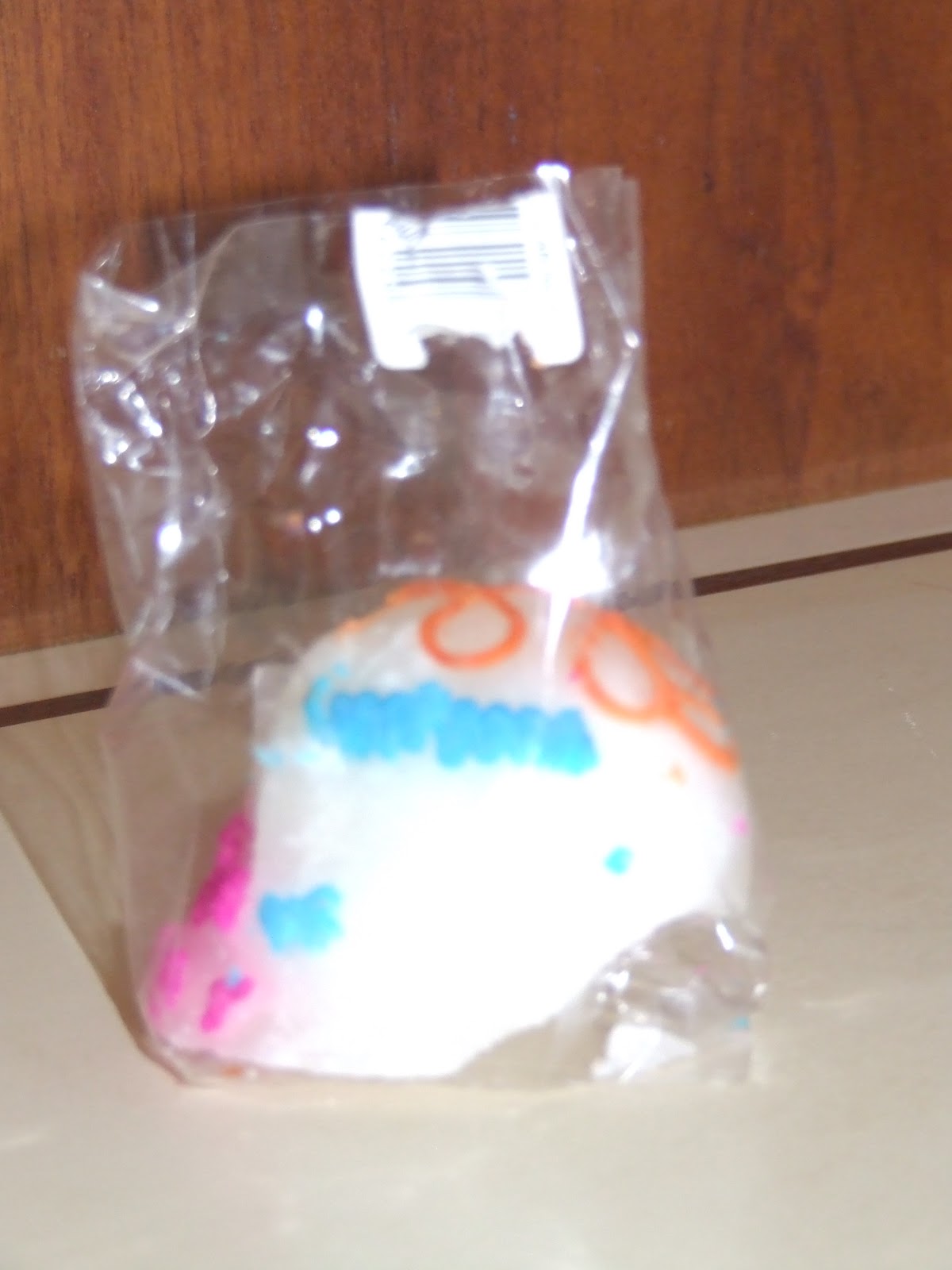
What we did purchase was a calavera – a skull made of sugar.  They’re everywhere.  There must be a giant plant extruding sugar skulls at a ferocious rate all through October somewhere in Mexico – note the UPC bar code! 

Indigenous Art . . . With Bar Code.

We placed our sugar skull in our altar place (next to the St. Christopher and the Buddha friends have provided us) to honor our departed family members.  On November 2, we unwrapped it and took a small bite.  Hmmm – it tasted as you might imagine: a tablespoon of sugar with that funky chemically flavor of colored icing.  We (reverently) sent it off to the great trash bin on the dock before it attracted any bugs.  We hope Howard (Bryce’s father) and Bob and Patti (Molly’s parents) came to visit us, and if they did, that they did not try the calavera, but that they enjoyed the thought that their crazy old children were living on a little boat in Mexico.  Molly is concerned that her mother is now worried that her daughter is living without air conditioning . . . something she often said was mankind’s greatest invention after indoor plumbing. 

The important take-away for us is that it’s nice to have a particular day set aside to invite those 
that we have loved to return to us for a party.  We’re planning on making this a part of our annual celebration ritual -- though we think we’ll keep the sugar skull inside its wrapper for direct deposit into the landfill next year. 

WE DID A GOOD DEED:  We joined fellow boaters in participating in the clean-up of nearby Balandra Beach one Sunday.  We were hot and sweaty by the end of our efforts – and had a huge Costco bag of trash to add to the pile being hauled off the beach. 

Litter Patrol
We picked up enough cigarette butts to atone for our former lives as smokers, and we learned that styrofoam lives longer in the blazing Baja sun than does the thin plastic used to make drinking cups (those would literally disintegrate in our hands as we tried to pick them up).   Longer lived still are chip packages.  We felt very virtuous about our efforts, and more importantly, were reminded not to purchase things in styrofoam and to keep our (oft forgotten) pledge to take reusable plastic with us to dinner to use as our take-home box! 

WE WILL OVERCOME THE INDOLENCE OF BEING LA PAUSED!  We are planning to depart La Paz on Thursday the 8th.  We need to buy propane and some food (we hear re-provisioning in the little villages in the Gulfo de California is limited), and get the dingy inflated and strapped onto the deck.  But there’s no need to rush anything really.  We’re retired you know.  Once we depart we’ll travel north to – well, however far we get.  We will write as we away.   

Monday, October 22, 2012

La Paz – and Abracadabra is Lovely!


We arrived in La Paz Saturday night to find Abracadabra in fine shape, and that – despite promises by Marina Palmira staff to do so -- no reservations had been made for us at the Marina Hotel.  This was complicated by the fact that a fiesta de quinceañera was being held at the hotel that night.  [Quinceañera is a Latino girl’s 15th birthday, which in Mexico is recognized as a combination religious-coming-of-age event and social debut (think: bat mitzvah and debutante ball in one long day).] 

After much distress and confusion at the front desk a room was finally found and we were able to shower off the dust of Mexico 1.  Our 480-ish mile drive from Guerrero Negro down Baja California Sur was slow and crowded.  Evidence of Hurricane Paul was everywhere: patches of road had been washed away, water was still standing in many places, and road crews were at work everywhere. 

Mexico 1 - Washed Away By Hurricain Paul

Traffic grew heavier the further south we went – think: sharing California Route 1 along the northern coast with other tourists and heavy commercial traffic – including huge car-delivery big-rigs.  Oh yeah, and the occasional band of burros.   

Road Block

DAY FOUR – Guerrero Negro to Santa Rosalia:   138-ish miles and 5-ish hours with a stop for lunch and an act of tourism.  At this point Mexico 1 travels across the width of the Baja peninsula to the Sea of Cortez (or Gulfo de California if you prefer).

We stopped at San Ignacio to see a mission church (those Jesuits were busy up and down all three of the Californias in the 1700’s). 

Mission at San Ignacio


Angels Watching From the Corners

San Ignacio is a very lush and green palm oasis, which was a welcomed change after driving through miles of dessert.  We lunched at a little place off the main square with the cutest restaurant puppy imaginable. 

That night we stayed in Santa Rosalia, on the Sea of Cortez; possibly the most “un-Mexican” looking town on the Baja.  A French mining company established the town at their mine site in the 1880’s, and operated the mine until the mid-1950’s.  The French strongly influenced the town’s architecture, and we were left with the feeling that we were visiting a town in French colonial Africa or the Caribbean. 

A House In Mexico?

The “must see” in Santa Rosalia is a prefabricated metal church reputedly designed by Gustave Eiffel (of Parisian tower fame).  The story is that the church was destined for some place in French colonial Africa and, for reasons lost to history, was instead sold to the French mining company in the 1890’s and shipped to Santa Rosalia.  It’s an interesting metal structure – not necessarily lovely, but interesting.

A Movable Church
Metal Beams - Courtesy of Mr. Eiffel?

We also visited a local marina and chatted with some boaters.  They had some exciting stories of Hurricane Paul, including reports of winds gusting to 60 knots in the marina, and broken docks.  But no boats were seriously damaged, so they were left primarily with a good story and a justification for as much “we’ve cheated death again” mid-afternoon beer as they wished for a day or two. 

Our night was spent at the Hotel Frances – an old, rickety hotel perched on a hill overlooking the Sea of Cortez and next door to the mine site.  The hotel is reputed (read enough tour materials and you, too, will begin to use the word “reputed”) to have housed those practitioners of the oldest profession that worked closely with the local miners.  The lobby of the hotel is very French – fabric walls and ornate furniture.  Unfortunately the hotel’s included breakfast was very – uh -- Spartan (toast, coffee and juice). 

Hotel Frances in Santa Rosalia

DAY FIVE – Santa Rosalia to La Paz:  346-ish miles and 9-ish hours with stops for gasoline, lunch and another church and marina.

Our last day on the road was very, very long.  We drove slowly through Mulegé, which is by all accounts the town most damaged by the hurricane.  There was quite a bit of damage visible, including some buildings that don’t look like they’re where they once were. 

We stopped for donuts and coffee at a funky little hostel at a seaside resort on Conception Bay.  The bay looks lovely and tranquil, and the hostel looks like a perfect place to try to negotiate “day pass” privileges (a hot shower, a place to take trash, and a place to buy a coffee or donuts now and then).  We’ve marked it on our map for future reference, in the event we get that far north on Abracadabra!

We stopped in Loreto which is just as charming as it is reported to be.  We visited the church – the “mother mission” for all those other Jesuit missions –

The Mother of the Missions


and ate lunch.  It’s worth a return trip.  We had originally planned to stay there for the night, but Captain Bryce was beginning to hear the call of the sea (or more accurately the call of “oh, geez, how has my boat weathered Hurricane Paul?”) and he promised he would do all of the driving if we pushed on to La Paz.  So, we drove on after a walk through the historic center of Loreto.

We made a brief stop at Puerto Escondido to see the marina and mooring area there.  It looks like a good potential stop along our sail north; particularly because there is a large grocery store within a short drive (all we’ll have to figure out is how to make that short drive when we have no car . . .).

At this point Mexico 1 veers to the west, back toward the Pacific Ocean.  At one point we could swear that we saw the Pacific out our passenger-side window!  The highway passes through Ciudad Insurgentes and Ciudad Constituion – but there doesn’t appear to be much to recommend either town except some Pemex stations. 

We arrived in La Paz very hot and dusty and glad (after the excitement as previously reported) to have a hotel room.  After looong showers, we walked the two-ish miles (which felt really nice after five looooong days in the car) to Buffalo BBQ which Molly firmly believes has the best steak salad in Mexico.  Thankful that all we experienced on this trip was the aftermath of the hurricane, and that our boat had come through the storm (which was light in La Paz) without any damage at all, we toasted our caution and good fortune with a drink, and walked back to the hotel.  We were kept awake much of the night by the music of the fiesta de quinceañera – but at least we had a hotel room! 

Today we heard that one boat owner slept in the church in the town of Mulegé because all the hotels there were full of people who had lost their homes, road workers, and stranded travelers.  Hmmm – adventure is one thing; discomfort another thing altogether!

Thursday, May 17, 2012

Decommissioning and Season Stats – April 21 to May 7

Decommissioning:  “Decommissioning” is a fancy way of describing the process of preparing one’s boat home to be unoccupied during Mexico’s hot season and hurricane season (which overlap by several months).  Though many hearty souls stay in the Sea of Cortez during the summer – we have been offered the opportunity to house sit for some friends in San Francisco for much of June and July.  Let’s see – 110 degrees in a small fiberglass container, wondering if a “named storm” (that’s insurance-speak) will take place in the summer of 2012 . . . or staying in a lovely condo in the best city in the world (yes, New Yorkers and Torontonians -- it's true). 

So we “decommissioned”.  Everything came off of the topsides (sails, barbeque, lifesling, biminy canvas, life raft - everything) and was stored either below or with our boat managers.   Abracadabra began to look like a sailboat again!
All food items were removed to “disincentivize” (government-speak) any opportunistic critters in the area.  Everything was scrubbed, including the outside of the oven (removed from brackets, pulled out, and scrubbed – ugh, just don’t ever look there, at home or on your boat).  So we now have the cleanest, shiniest stove on the entire Baja coast - or perhaps on the entire planet!


All wood surfaces were oiled.  The head was scrubbed.  Abracadabra was so clean we briefly considered putting her on the market just because she looked so ready for boat brokerage pictures . . . but not really!
We arranged for Abracadabra to stay at Marina Palmira until October, and hired Buceo Bahia, a La Paz company, to take care of her.  They will periodically wash the bottom, check zincs, start the engine, check the electrical usage, and if (hopefully not) needed prepare her to weather any storm, including any “named storm”. 

After being squeezed out of the v-berth by topside stuff, (below is what was our bed!):

we were then squeezed out of the “guest suite” (aka the salon) by even more topside stuff!  Below Molly is taking refuge in the "guest suite" before the berth there was occupied by the life raft:


We finally decamped for a couple of days to a very nice bed and breakfast in La Paz – Casa el Centro.  We had thought we’d have time for a “vacation” once we prepared Abracadabra for the summer, but we had only a day in La Paz without trips to the marina to do some other last minute thing.  It's a boat - there's always something to do.
Season Stats:  We thought it would be interesting to consider our first season from a statistical point of view, so here are some “first season stats” for Abracadabra:  
  • Days of Travels On Abracadabra: October 7, 2011 – May 7, 2012 = 213 days
  • Nautical Miles Traveled:  2639
  • Guest Crew: Frank Chan and Irene DeBrujin-Chan; Rick Nelson and Corinne Hackbarth; Jodi Rafkin; Bob Romano; and Jim Thompson (thanks all -- we loved having visitors -- particularly fellow sailors!!)
  • Nautical Miles Traveled With Crew:  1424 w/ crew (1205 w/out)
  • Nights Underway:  19
  • Nights Underway With Crew:  10
  • Nights at Anchor / on a Mooring Ball:  39
  • Favorite Anchorage:  Chacala
  • Least Favorite Anchorage/Mooring:  Pichilinque or Yalapa -- it's a tie (though we would love to return to Yalapa WITHOUT staying on a mooring ball!)
  • Marina Stays:  155 nights (including two-ish weeks for repairs; two-plus-ish weeks to decommission; two week for a road trip and assorted days to recover from colds, etc.)
  • Engine Hours:  255.2 (assuming 4.5 miles per hour to take into account water making etc. = 1148 miles or less than half of the trip!)
  • Road Trips:  Guanajuato -- read the blog post about that trip and make sure you visit this wonderful city if you have a chance!
  • Injuries:  2 jammed/broken/and/or wrenched toes (1 Jodi, 1 Molly); 1 toe tip removal (Bryce - just the tiniest bit, but he's now finally installed a bungee cord to hold up the anchor locker hatch!); 1 broken foot (only the tiny little bones on top - but quite spectacular bruising - Molly); 1 set of blackened fingernails (Bryce - but he won't open that hatch the same way again); 1 wrenched shoulder (Bryce - but he's getting much better at controlling the dinghy).  Did we forget others' injuries (?) . . . we mostly remember our OWN.
  • Blog Posts:  25 to date
  • Most Interesting Page Views:   5 from Latvia (we think we know who is viewing in Kazakhstan, but who do we know in Latvia?)
Thoughts For Next Season Based On These Stats: 
  • We'd like to spend less time in marinas (though much time this season was due to repairs,  decommissioning time and road trips . . . so perhaps significant marina time is unavoidable?).
  • We'd like to spend even less time motoring (though sometimes having the motor on isn't for the sole purpose of making miles, but is necessary to fill batteries, and other times the motor is required to get there before dark, though perhaps we can become proficient in braille anchoring . . . )?  And why are we so obsessed with avoiding the motor?  Well, it's noisy and somewhat stinky, but most importantly, to quote our fellow sailor Frank Chan:  "Because we're sailors."
  • We'd like to have fewer crew injuries, so maybe we'll post one of those inspiring "X days without injury on this work site" signs . . . or better yet, buy sandals with toe protection!
Goodbye to Abracadabra:  Finally, on the 6th of May, we tearfully (though El Capitan might not admit it, he was spotted blinking rapidly as we walked away . . . ) left Abracadabra knowing that she would be in the good care of Buceo Bahia,


and on the 7th, we flew to Tijuana, picked up the cross-border bus . . . and arrived in El Norte. 

Soon we’ll blog briefly about our “plans” for the summer (such as they are) and update our marina reviews – and then sign off until we return to Mexico next fall to take up Travels on Abracadabra again. 

Tuesday, May 15, 2012

La Paz and the Gulf of California -- April 13 – 19

Our friend Jim Thompson joined us at the Marina Costa Baja in La Paz on April 11th.  Many of the pictures on this blog post are courtesy of our guest photographer! 
Marina Costa Baja is lovely – but a bit too full of mega yachts for the crew of Abracadabra to feel comfortable.  After a brief stay which included a couple trips into La Paz proper to try some of the local restaurants and provision at Mega (see our most recent Mazatlán post on why we go to such “mega” stores!), we set off for a seven day sail among the islands near La Paz.  These four islands – Islas Espiritu Santo, Partida, San Francisco and San Jose – are all part of Mexico’s national park system. 
As former civil servants we believe in government and what it can provide its citizens, so we did our best to honor the requirement that all boats that anchor in Mexico’s national parks purchase a park permit.  Unfortunately none of the places that are designated sellers of park permits had any available!  We were told that the park ranger (singular?) would be able to provide us with a permit once we were within the park area – that the ranger was aware that there were no permits available in La Paz.  During our five+ days within the park area we never saw a (the?) ranger. 
[Side rant:  Take comfort, all ye that hate taxes and the “nanny state” environments in California and Canada  – there are places where either taxes are low or their distribution is ineffective, government services are correspondingly limited, and one can roam in national parks freely.  We hope the intended irony of this last bit comes across in writing.  We’ve spent a little too much time listening to that subset of cruisers that want to live without rules (and, most importantly, the taxes that fund the enforcement of such rules).  Interestingly, our impression (albeit the result of a highly unscientific survey) is that these same “live free” people expect those around them to somehow spontaneously conform to the “live free” person’s view of proper behavior. . . hmmm.  Nasty, brutish and short, anyone?  Okay, off soapbox and back to our trip:]
During our week we saw spectacular stars, birds and sea creatures (below is a sea turtle):


Alas, whales appeared only at a far distance. 

We saw dramatic scenery, and stunningly blue and green water:


And we had several opportunities to consider that the locals have actually named the various types of winds that blow through the La Paz area.  Much like the oft-repeated story of the number of words northern indigenous peoples have for snow, these different names for wind offer a lot of information about sailing in the area!
Day 1 – Isla Espiritu Santo:  Our first day out we crossed over to the island of Espiritu Santo, which lies some 20 miles off of La Paz.  We had a lovely sail, and even flew the spinnaker late in the afternoon.  We anchored in Ensenada del Candelero (Candlestick Cove – Go Niners) and tucked in behind the huge rock that dominates the middle of the cove – Roca Monumento.

Having been introduced to the Coromuel (see prior post from our crossing to La Paz – this is a strong south or southwest wind), Bryce and Molly were able to inform Jim of the name of the wind that came up shortly after dinner.  Given the small size of the cove, our proximity to the somewhat daunting Roca Monumento, and the strength of our previously experienced Coromuel, we decided to take watches to confirm that Abracadabra remained securely anchored.
Days 2 and 3 – Isla San Francisco:   The next day we sailed to Isla San Francisco, an island north of Espiritu Santo.  The winds were brisk and from the north – the opposite direction of the Coromuel that had kept us up the night before -- and almost directly on our nose.  How unfair!  So we sailed a relatively ziggy and zaggy course in choppy waves to achieve our destination.
The Isla San Francisco anchorage was a bit crowded, including a very large and brightly lit motor yacht.  We were not invited over for a drink on the boat, nor were we offered a ride in their helicopter. 


But we showed them – we had our Cuban rum and Coca Light over ice without inviting them to join us.  Of course since Abracadabra’s ice maker (of which we are very proud!) only makes about 24 cubes every 24 hours, our revelry couldn’t really get out of hand.   
The anchorage at San Francisco provided both spectacular scenery – red hills rising above a clear aqua bay in one direction, and an arching white sand beach in the other – and relatively calm shelter from the north winds.
The next day we took a short dinghy ride to shore.  We might have impressed Jim with our ability to nonchalantly land the dinghy had we not confessed that the lack of surf in the anchorage made this one of the easiest spots to beach land that we’d experienced.  We collected a few shells, and then walked across the narrow spit of land between our anchorage and a little bay on the other side of the island.  Not more than a quarter mile apart, the two bays -- one with a southern exposure (our anchorage) and one with a northern exposure -- could not have been more different.  Because of the prevailing north winds, our anchorage had a beautiful soft white sand beach and gently lapping surf, the other bay was rocky and rough, with heavy surf.  Location, location, location. 
Day 4 – Isla San Jose:  The next morning we performed the hot-shot maneuver of sailing off the anchor to please our Captain.  Easy for him – Molly was at the helm and kept thinking how unpleasant it would be if the wind was too light, causing us to drift into our neighbor boats with a thud at 0700!  But as usual, El Capitain knew his boat and read the wind and we sailed out of the anchorage easily. 
The rest of our sail was more vigorous – we had winds from the north up to 18 knots, and steep wind waves.  We were now experiencing what the locals call a Norther.  A Norther is the result of a high pressure system over Arizona, and when one is trying to sail north – it can be quite cold.  When severe, a Norther is called a Screaming Blue Norther.  Fortunately, we didn’t get to the screaming blue stage - but the colder weather did affect Jim’s sunbathing attire:

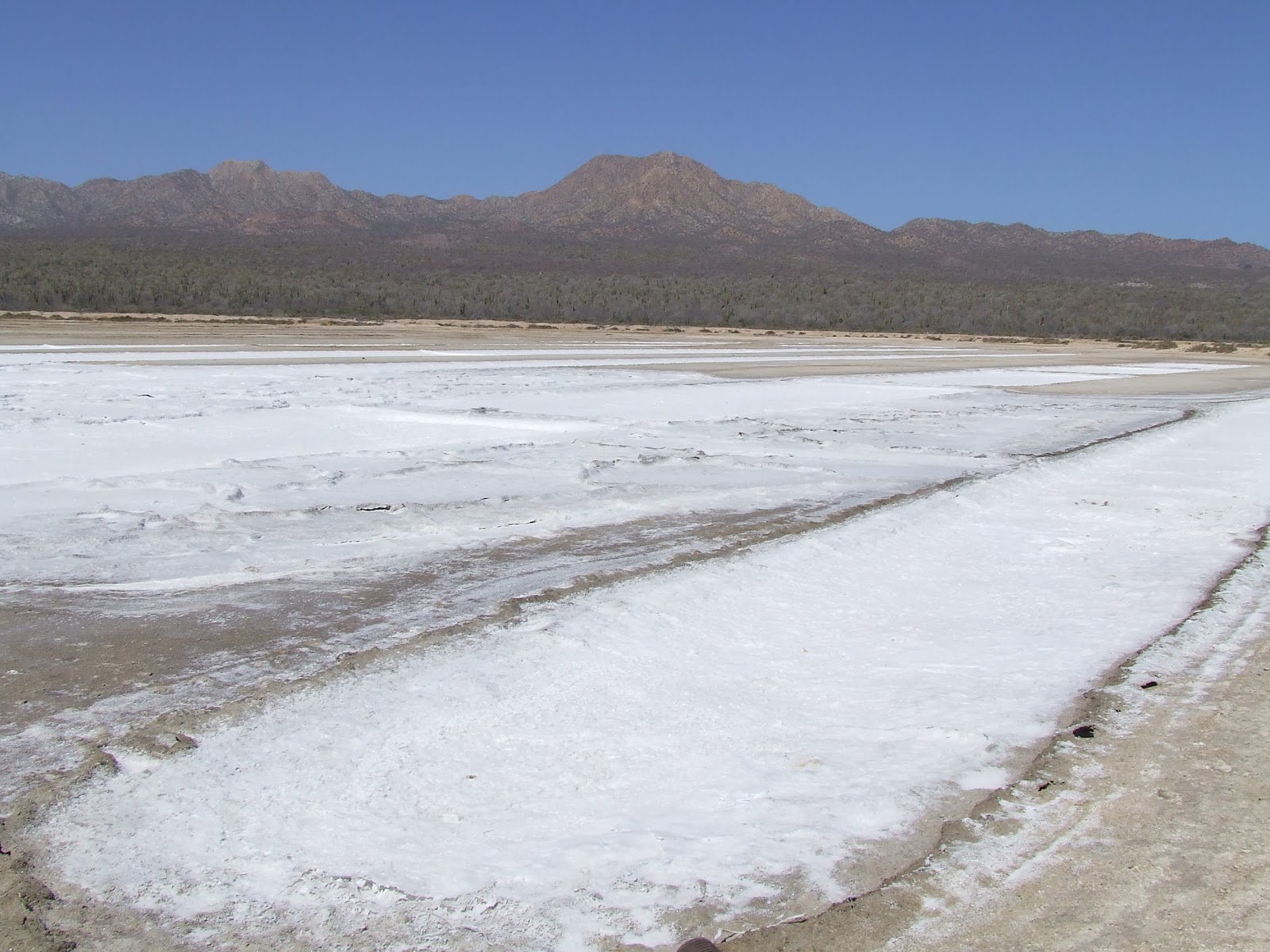
On Isla San Jose we anchored in the bay created by Punta San Ysidro.  Once again there was spectacularly blue and green water and a long, white sand beach.  The island is also the home of some abandoned salt works: 


And some areas that looked like ponds still being used to gather salt:
Someone visiting the island had taken the opportunity to create what we think San Franciscans would refer to as “performance art” in one of the abandoned buildings.  Welcome to Zapateria Reno (Reno's Shoe Store):


We didn't find anything that was "just us".
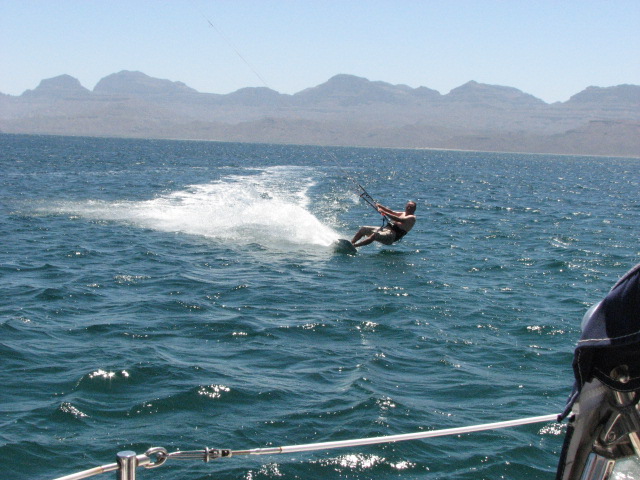
Perhaps the most exciting moment of our time at this anchorage was provided by a fellow cruiser, who was performing some spectacular kite surfing maneuvers – including jumping over Abracadabra’s stern!  While yelling something like “OMG come look at this!” Jim did his best to capture the moment:


Day 5 – to San Evaristo:  The next day, after considering where we might be best protected from the Norther, and the fact that we needed to begin thinking about returning to La Paz to our south, we weighed anchor and motored to the mainland. 
After anchoring off of the little (no more than 20 houses) village of San Evaristo, protected from north winds by Punta San Evaristo, we agreed that, in honor of the Norther we would not leave Abracadabra unattended.  Bryce and Jim went to shore and bought a kilo of fish from some fishermen that were offloading their day’s catch.  Even better, the fishermen filleted the fish for us (no, Corinne we have not gotten any better at filleting fish!). 

We were told it was a pargo, though looking on the internet that seems unlikely – pargo is reportedly an Atlantic fish.  Whatever it was, it was really, really tasty when pan sautéed with some thyme and served with some rice and chayote squash and some lime for squeezing.  Clearly the culinary highlight of the trip.  Better (even Molly agrees) than the Betty Crocker brownies baked on the first night at anchor!      
While Jim took a turn watching our anchor position, Bryce and Molly took a tour of the village and chatted up some very tired looking kayakers who were hoping to get a weather report from us.  We passed on the information we had received from the kind folks on S/v Lumba Lumba – which was that the wind was to shift to a southerly direction - just in time for us to be sailing directly into the wind as we headed south.  This wasn’t what the leader of the kayak expedition really wanted to hear either, and we commiserated with him.  And after he was out of earshot we congratulated ourselves on the fact that, though we might be sailing close hauled and zig-zagging our way south, we at least didn’t have to paddle into the wind!).
Day 6 – to Ensenada Grande:  From San Evaristo we sailed south about 24 miles to a large anchorage on Espiritu Santo, aptly named Ensenada Grande. 
Ho hum, another spectacularly beautiful anchorage . . .


Day 7 – to Marina Palmira in La Paz:
And our final day, we returned to La Paz.  The winds were fascinating – by staying close hauled Abracadabra arced almost 90 degrees on the same closed-hauled tack, and we were able to sail into La Paz.  Just because he knew we could, El Capitain put up the spinnaker and sailed down the entry channel into La Paz.  It was his last sail of the season . . . and he wanted to make it count. 
We arrived at Marina Palmira, which is to be Abracadabra’s home for the summer season.  Jim departed,

and we began the process of “decommissioning” – or more accurately, preparing our boat and our home for the hurricane season.  More about that to come.

Thursday, April 26, 2012

Sights of La Paz

Our friend Jim Thompson – a friend of Bryce’s from his aerial survey days and fellow sailor – joined us in La Paz on April 11th.  After a brief visit we set off for a seven day sail among the islands near La Paz, which we'll blog about soon.  We returned after that trip to La Paz, where we are now decommissioning Abracadabra for the summer.  We'll also blog (aka complain) about the decommissioning process and blog (aka brag/warn you) about our plans for the summer.  In the meantime, here are some sights of La Paz, many of which Jim captured and shared with us - others are courtesy of Abracadabra's official photographer, Captain Bryce.

The doorways and courtyards of La Paz are as intriguing as in other Mexican cities:


And behind the low unemployment figures in Mexico, occasionally lurks some poor soul that will have a "worst job ever" story to tell some day!

And down a side street -- without fanfare or explanation -- was a magical little art-filled park: